Does 5S really improve productivity?
What does science say?
Answer
Yes.
When implemented well and sustained.
5S creates value when it improves workplace visibility, flow and standardization — and when daily discipline sustains the new condition.
Strongest evidence
Peer-reviewed reviews and empirical studies generally associate 5S with better workplace organization, visual control, flow, quality and operational performance. The evidence is heterogeneous and largely based on case, survey and observational research.
The steps, in order
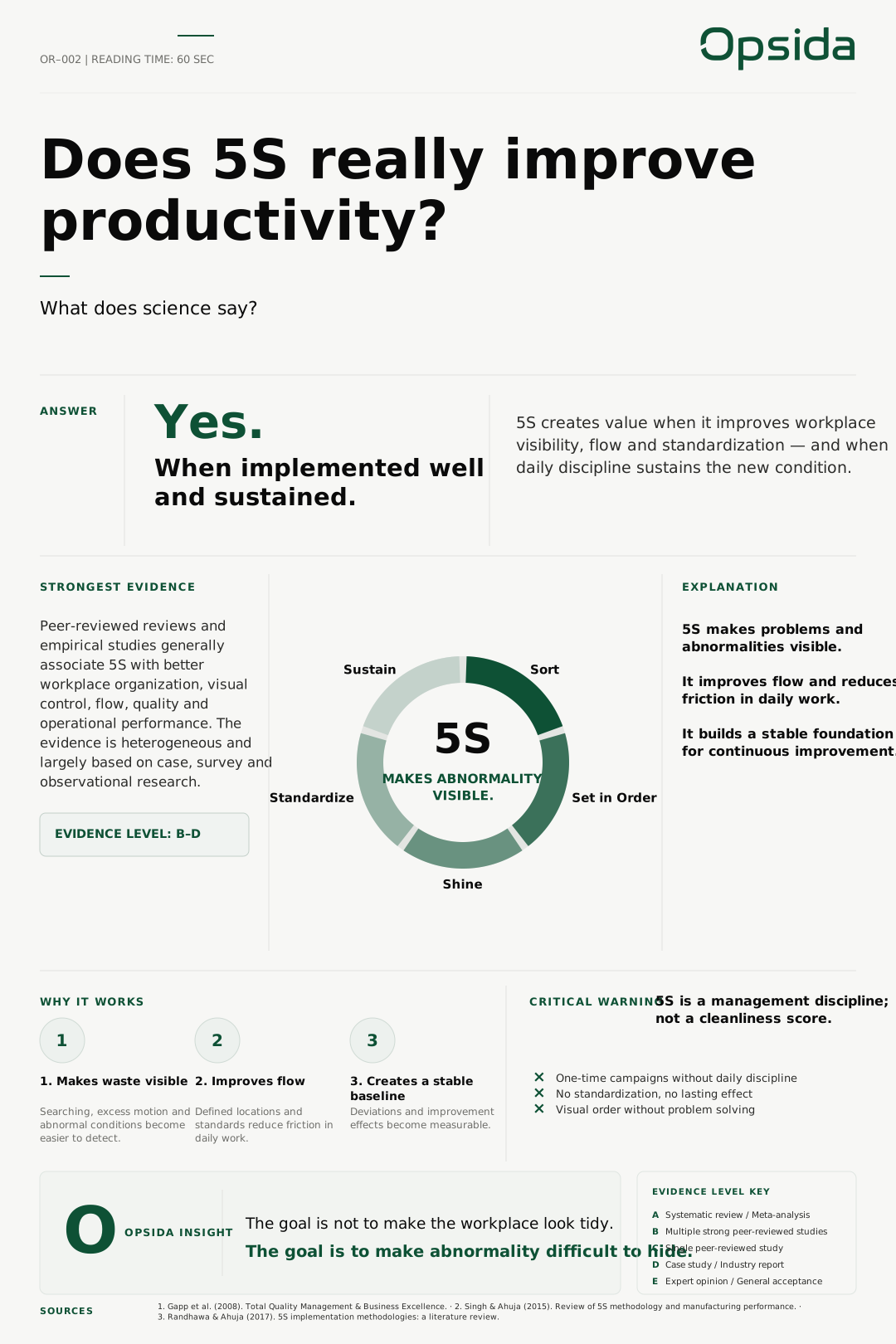
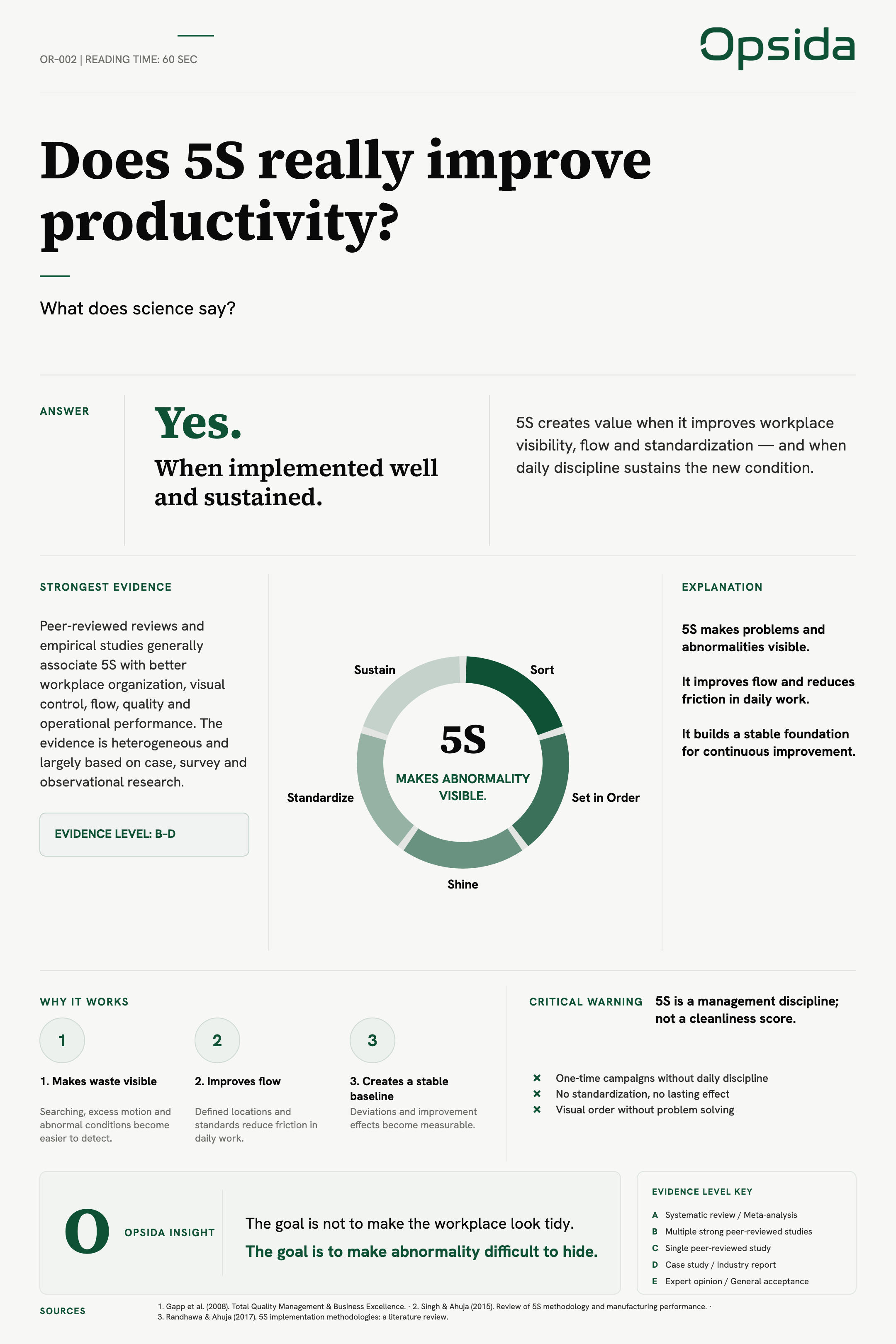
5S makes abnormality visible.
- SortEverything unnecessary leaves the area.
- Set in OrderEvery remaining item gets a defined place.
- ShineCleaning doubles as inspection.
- StandardizeThe first three steps become a written standard.
- SustainThe standard is held by audit and habit.
Explanation
- 5S makes problems and abnormalities visible.
- It improves flow and reduces friction in daily work.
- It builds a stable foundation for continuous improvement.
Why it works
Makes waste visible
Searching, excess motion and abnormal conditions become easier to detect.
Improves flow
Defined locations and standards reduce friction in daily work.
Creates a stable baseline
Deviations and improvement effects become measurable.
Critical warning
5S is a management discipline; not a cleanliness score.
- One-time campaigns without daily discipline
- No standardization, no lasting effect
- Visual order without problem solving
Opsida insight
The goal is not to make the workplace look tidy.
The goal is to make abnormality difficult to hide.
Sources
Gapp, R., Fisher, R., & Kobayashi, K. (2008). Implementing 5S within a Japanese context: an integrated management system. Management Decision, 46(4), 565–579.
Singh, A., & Ahuja, I. S. (2015). Review of 5S methodology and its contributions towards manufacturing performance. International Journal of Process Management and Benchmarking, 5(4), 408–424.
Randhawa, J. S., & Ahuja, I. S. (2017). 5S implementation methodologies: literature review and directions. International Journal of Productivity and Quality Management, 20(1), 48–74.
Evidence level key
- A
- Systematic review / Meta-analysis
- B
- Multiple strong peer-reviewed studies
- C
- Single peer-reviewed study
- D
- Case study / Industry report
- E
- Expert opinion / General acceptance
Poster
The full issue as a single sheet — the same content, laid out for printing and sharing.