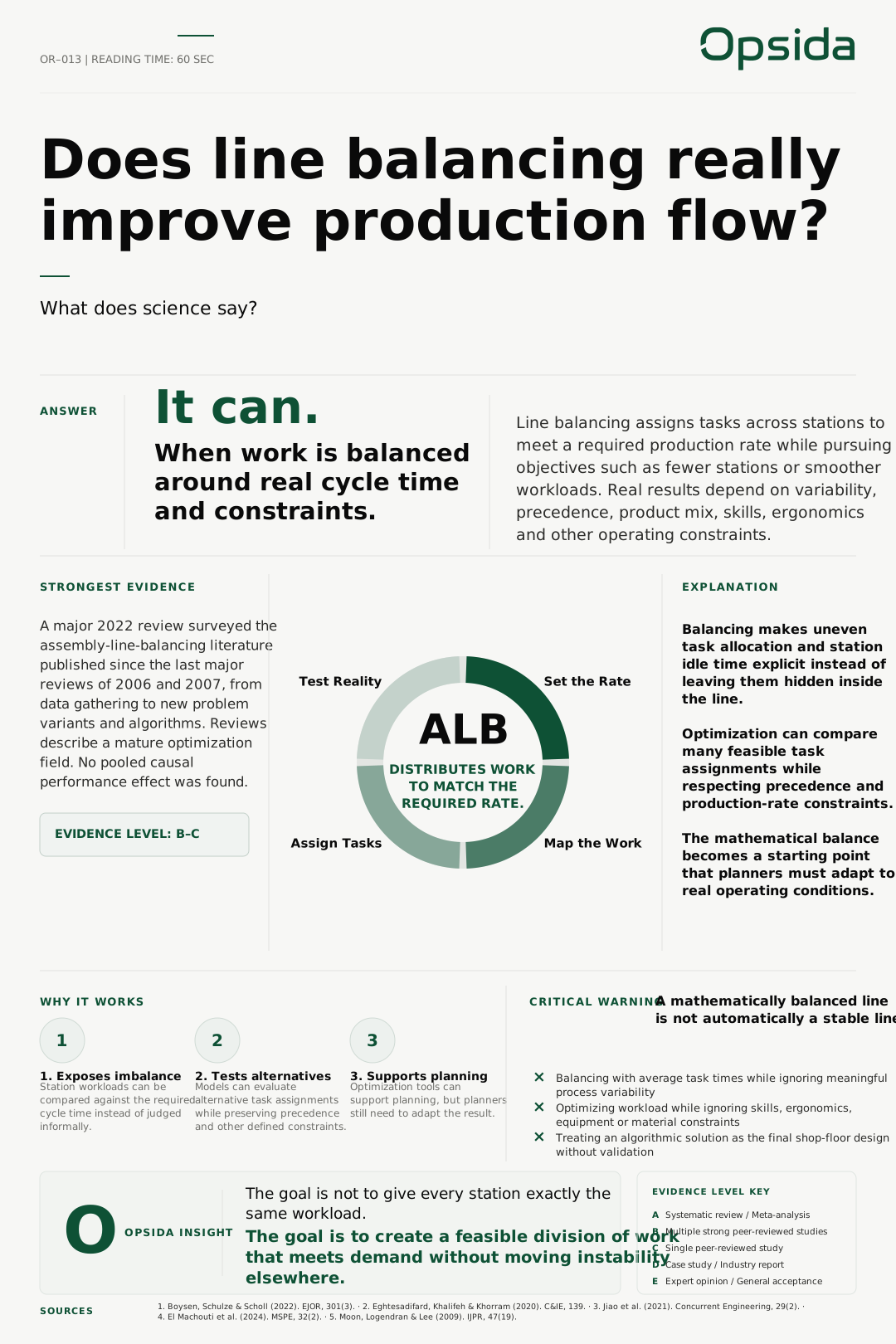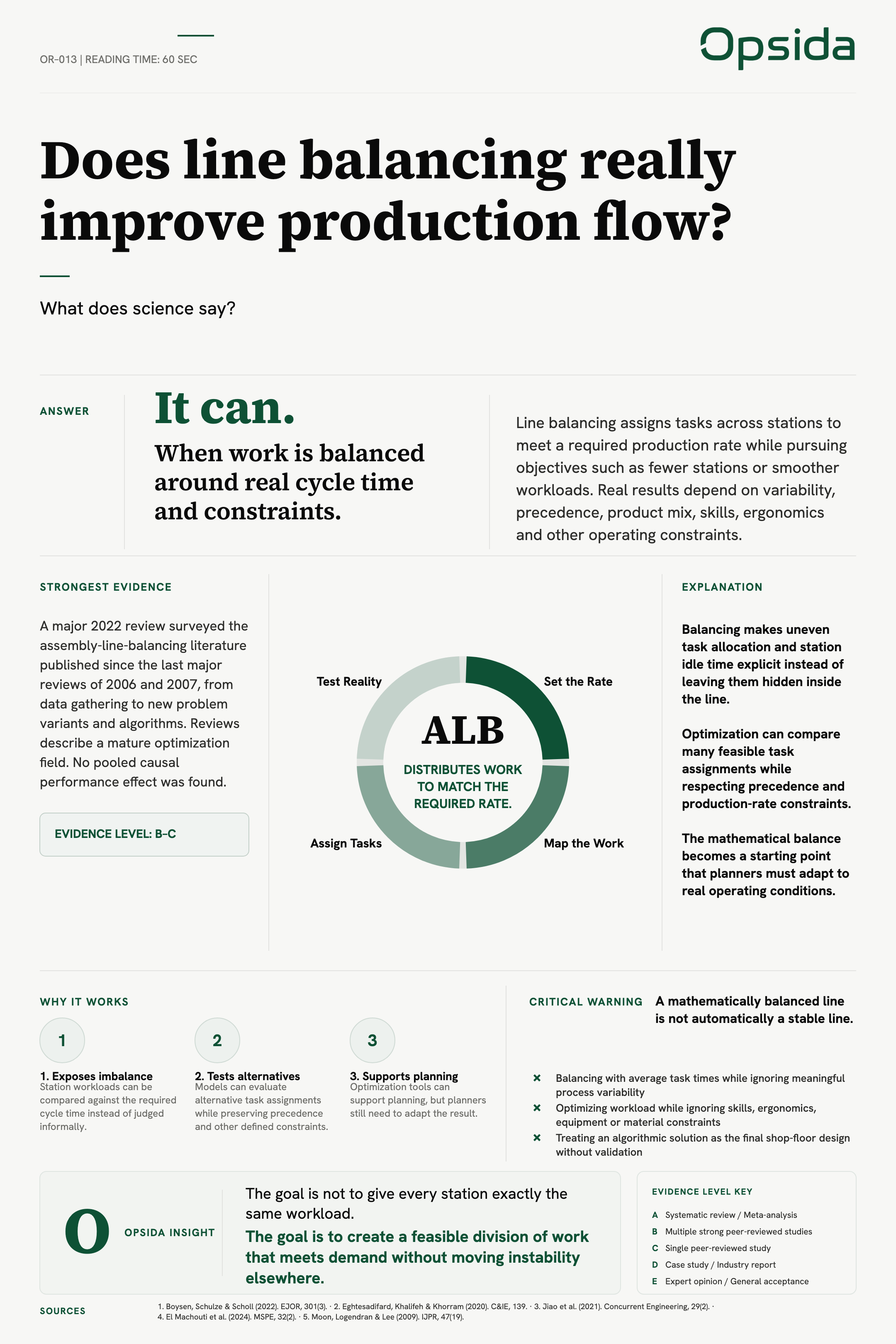
Does line balancing really improve production flow?
What does science say?
Answer
It can.
When work is balanced around real cycle time and constraints.
Line balancing assigns tasks across stations to meet a required production rate while pursuing objectives such as fewer stations or smoother workloads. Real results depend on variability, precedence, product mix, skills, ergonomics and other operating constraints.
Strongest evidence
A major 2022 review surveyed the assembly-line-balancing literature published since the last major reviews of 2006 and 2007, from data gathering to new problem variants and algorithms. Reviews describe a mature optimization field. No pooled causal performance effect was found.
The steps, in order
ALB distributes work to match the required rate.
- Set the RateDefine the production requirement and the cycle-time constraint the line must satisfy.
- Map the WorkCapture task times, precedence relationships and relevant resource constraints.
- Assign TasksAllocate tasks to stations while respecting precedence and cycle-time limits.
- Test RealityValidate the balance against variability, skills, ergonomics and actual shop-floor conditions.
Explanation
- Balancing makes uneven task allocation and station idle time explicit instead of leaving them hidden inside the line.
- Optimization can compare many feasible task assignments while respecting precedence and production-rate constraints.
- The mathematical balance becomes a starting point that planners must adapt to real operating conditions.
Why it works
Exposes imbalance
Station workloads can be compared against the required cycle time instead of judged informally.
Tests alternatives
Models can evaluate alternative task assignments while preserving precedence and other defined constraints.
Supports planning
Optimization tools can support planning, but planners still need to adapt the result.
Critical warning
A mathematically balanced line is not automatically a stable line.
- Balancing with average task times while ignoring meaningful process variability
- Optimizing workload while ignoring skills, ergonomics, equipment or material constraints
- Treating an algorithmic solution as the final shop-floor design without validation
Opsida insight
The goal is not to give every station exactly the same workload.
The goal is to create a feasible division of work that meets demand without moving instability elsewhere.
Sources
Boysen, N., Schulze, P., & Scholl, A. (2022). Assembly line balancing: What happened in the last fifteen years? European Journal of Operational Research, 301(3), 797–814.
Eghtesadifard, M., Khalifeh, M., & Khorram, M. (2020). A systematic review of research themes and hot topics in assembly line balancing through the Web of Science within 1990–2017. Computers & Industrial Engineering, 139, 106182.
Jiao, Y., Jin, H., Xing, X., Li, M., & Liu, X. (2021). Assembly line balance research methods, literature and development review. Concurrent Engineering, 29(2), 183–194.
El Machouti, S., Hlyal, M., Babay, A., & El Alami, J. (2024). Optimisation of Simple Assembly Line Balancing Problem Type E: A systematic literature review. Management Systems in Production Engineering, 32(2), 162–173.
Moon, I., Logendran, R., & Lee, J. (2009). Integrated assembly line balancing with resource restrictions. International Journal of Production Research, 47(19), 5525–5541.
Evidence level key
- A
- Systematic review / Meta-analysis
- B
- Multiple strong peer-reviewed studies
- C
- Single peer-reviewed study
- D
- Case study / Industry report
- E
- Expert opinion / General acceptance
Poster
The full issue as a single sheet — the same content, laid out for printing and sharing.