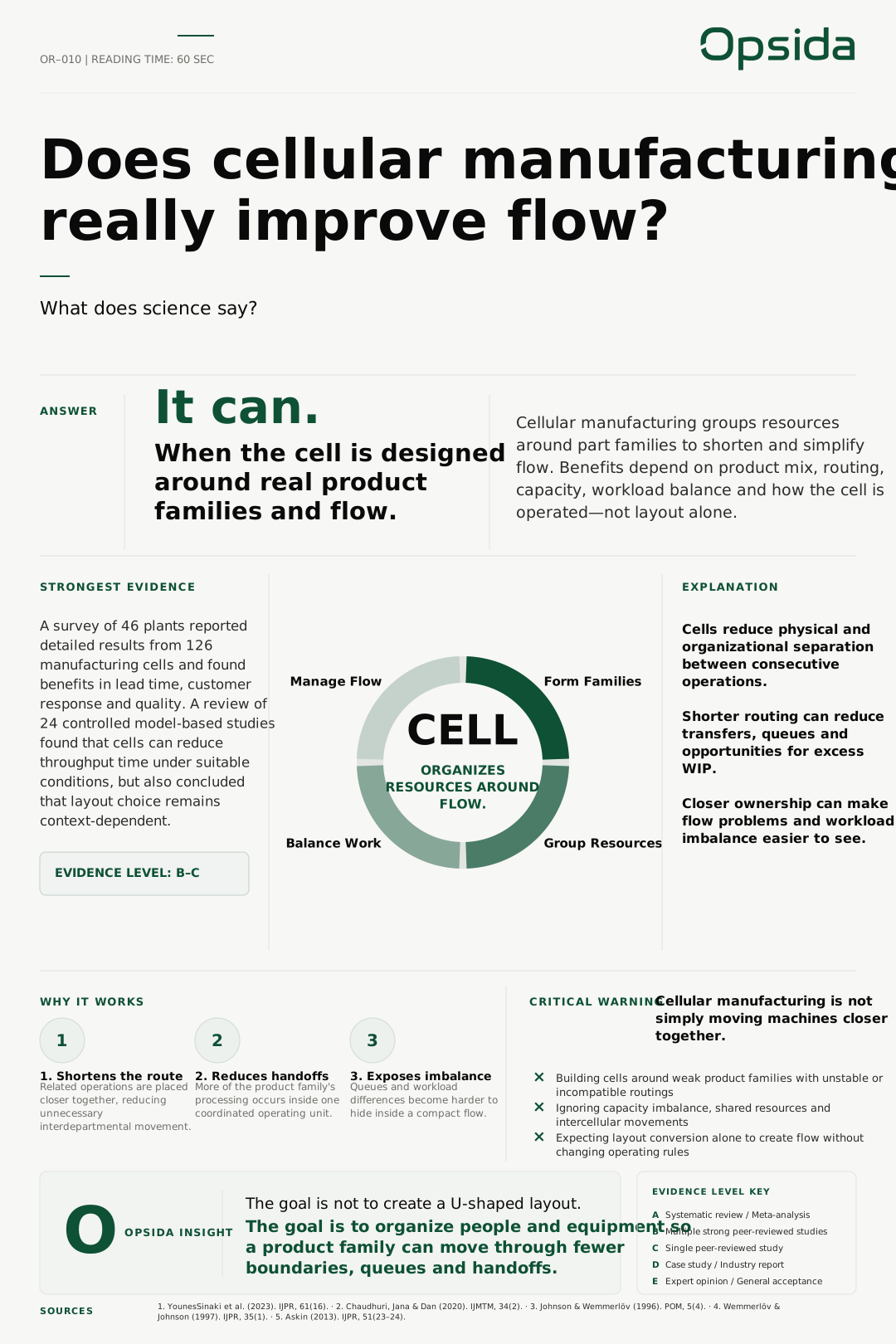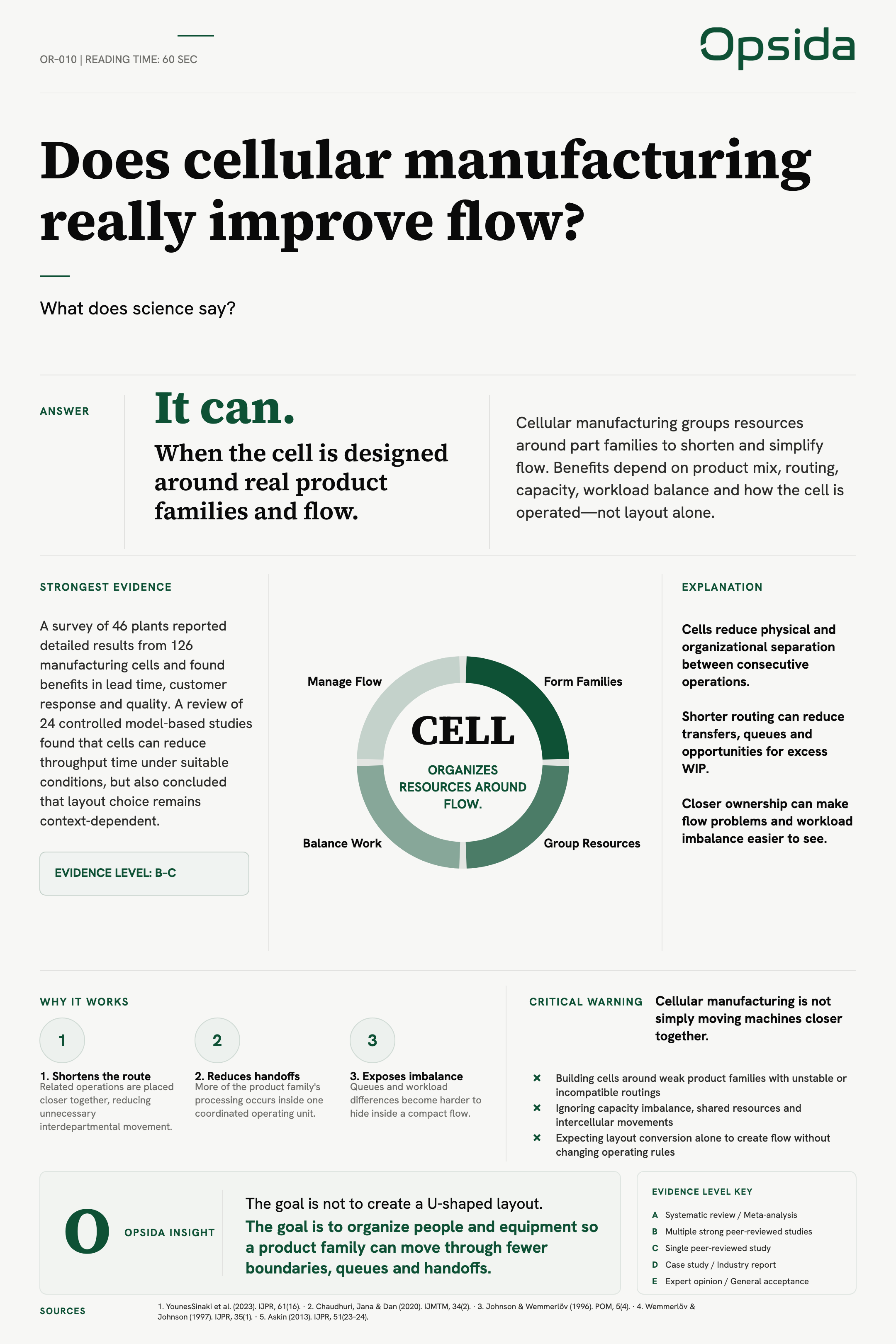
Does cellular manufacturing really improve flow?
What does science say?
Answer
It can.
When the cell is designed around real product families and flow.
Cellular manufacturing groups resources around part families to shorten and simplify flow. Benefits depend on product mix, routing, capacity, workload balance and how the cell is operated—not layout alone.
Strongest evidence
A survey of 46 plants reported detailed results from 126 manufacturing cells and found benefits in lead time, customer response and quality. A review of 24 controlled model-based studies found that cells can reduce throughput time under suitable conditions, but also concluded that layout choice remains context-dependent.
46manufacturing plants studied126 manufacturing cells documented · Multi-plant observational survey
The steps, in order
CELL organizes resources around flow.
- Form FamiliesGroup products with sufficiently similar processing requirements and routings.
- Group ResourcesPlace the required machines, tools and people around the family flow.
- Balance WorkAlign workloads and capacity so one operation does not dominate cell performance.
- Manage FlowControl WIP, sequencing and exceptions so the cell behaves as an integrated system.
Explanation
- Cells reduce physical and organizational separation between consecutive operations.
- Shorter routing can reduce transfers, queues and opportunities for excess WIP.
- Closer ownership can make flow problems and workload imbalance easier to see.
Why it works
Shortens the route
Related operations are placed closer together, reducing unnecessary interdepartmental movement.
Reduces handoffs
More of the product family's processing occurs inside one coordinated operating unit.
Exposes imbalance
Queues and workload differences become harder to hide inside a compact flow.
Critical warning
Cellular manufacturing is not simply moving machines closer together.
- Building cells around weak product families with unstable or incompatible routings
- Ignoring capacity imbalance, shared resources and intercellular movements
- Expecting layout conversion alone to create flow without changing operating rules
Opsida insight
The goal is not to create a U-shaped layout.
The goal is to organize people and equipment so a product family can move through fewer boundaries, queues and handoffs.
Sources
YounesSinaki, R., Sadeghi, A., Mosadegh, H., Almasarwah, N., & Suer, G. (2023). Cellular manufacturing design 1996–2021: A review and introduction to applications of Industry 4.0. International Journal of Production Research, 61(16), 5585–5636.
Chaudhuri, B., Jana, R. K., & Dan, P. K. (2020). A review on the multi-objective cell formation problem in cellular manufacturing systems. International Journal of Manufacturing Technology and Management, 34(2), 188–209.
Johnson, D. J., & Wemmerlöv, U. (1996). On the relative performance of functional and cellular layouts: An analysis of the model-based comparative studies literature. Production and Operations Management, 5(4), 309–334.
Wemmerlöv, U., & Johnson, D. J. (1997). Cellular manufacturing at 46 user plants: Implementation experiences and performance improvements. International Journal of Production Research, 35(1), 29–49.
Askin, R. G. (2013). Contributions to the design and analysis of cellular manufacturing systems. International Journal of Production Research, 51(23–24), 6778–6787.
Evidence level key
- A
- Systematic review / Meta-analysis
- B
- Multiple strong peer-reviewed studies
- C
- Single peer-reviewed study
- D
- Case study / Industry report
- E
- Expert opinion / General acceptance
Poster
The full issue as a single sheet — the same content, laid out for printing and sharing.