Does production leveling really stabilize manufacturing?
What does science say?
Answer
It can.
When demand variation can be absorbed without creating new waste.
Heijunka levels production volume and mix to reduce schedule unevenness. Its value depends on demand, product variety, capacity, changeovers and the cost of buffers required to decouple production from orders.
Strongest evidence
A 2024 systematic review examined 60 Heijunka articles and found three main research streams: implementation and benefits, optimization, and Industry 4.0. Evidence supports leveling as a stability mechanism, but empirical research remains limited and no universal performance effect has been established.
60Heijunka articles reviewed2024 systematic literature review · Systematic literature review
The steps, in order
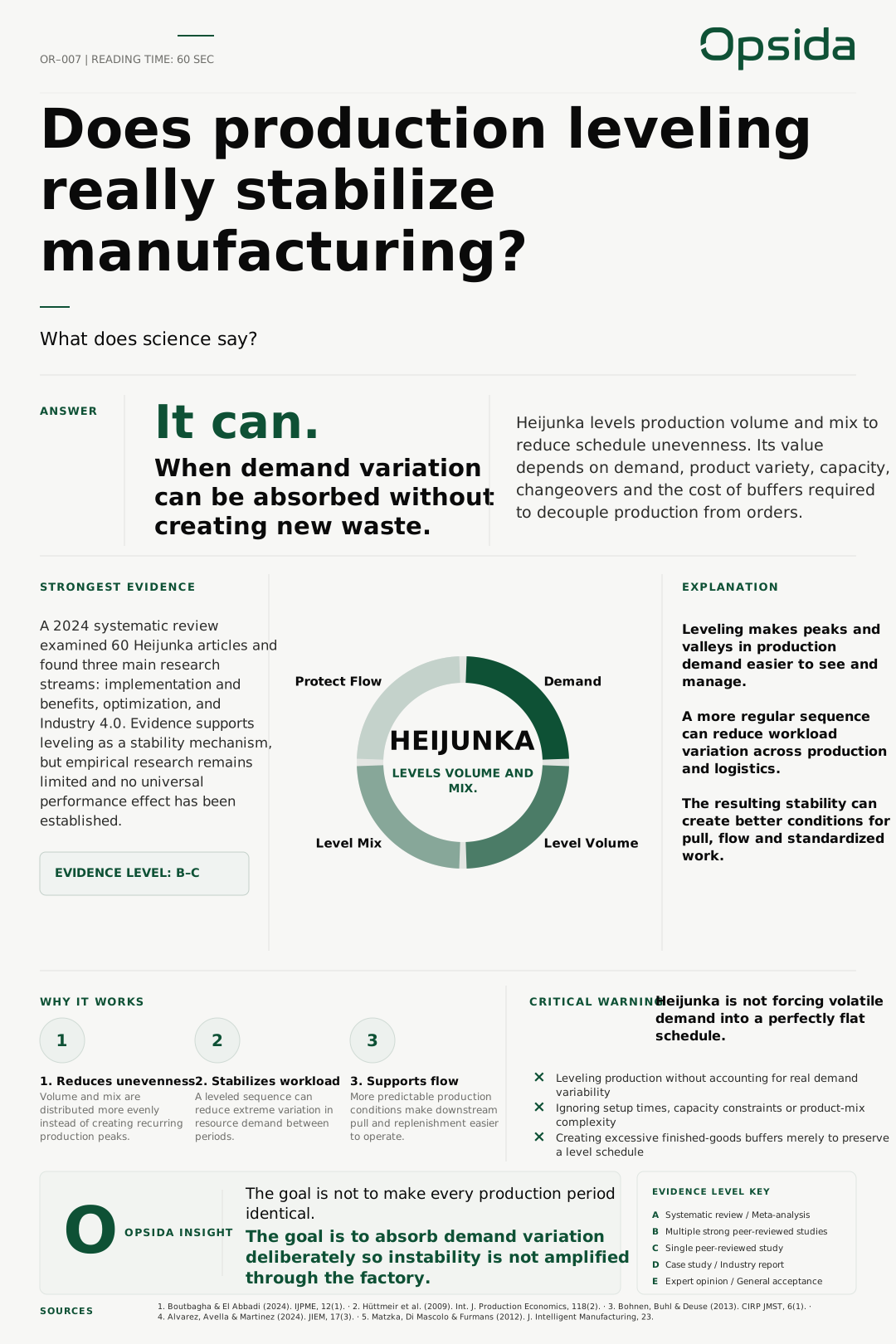
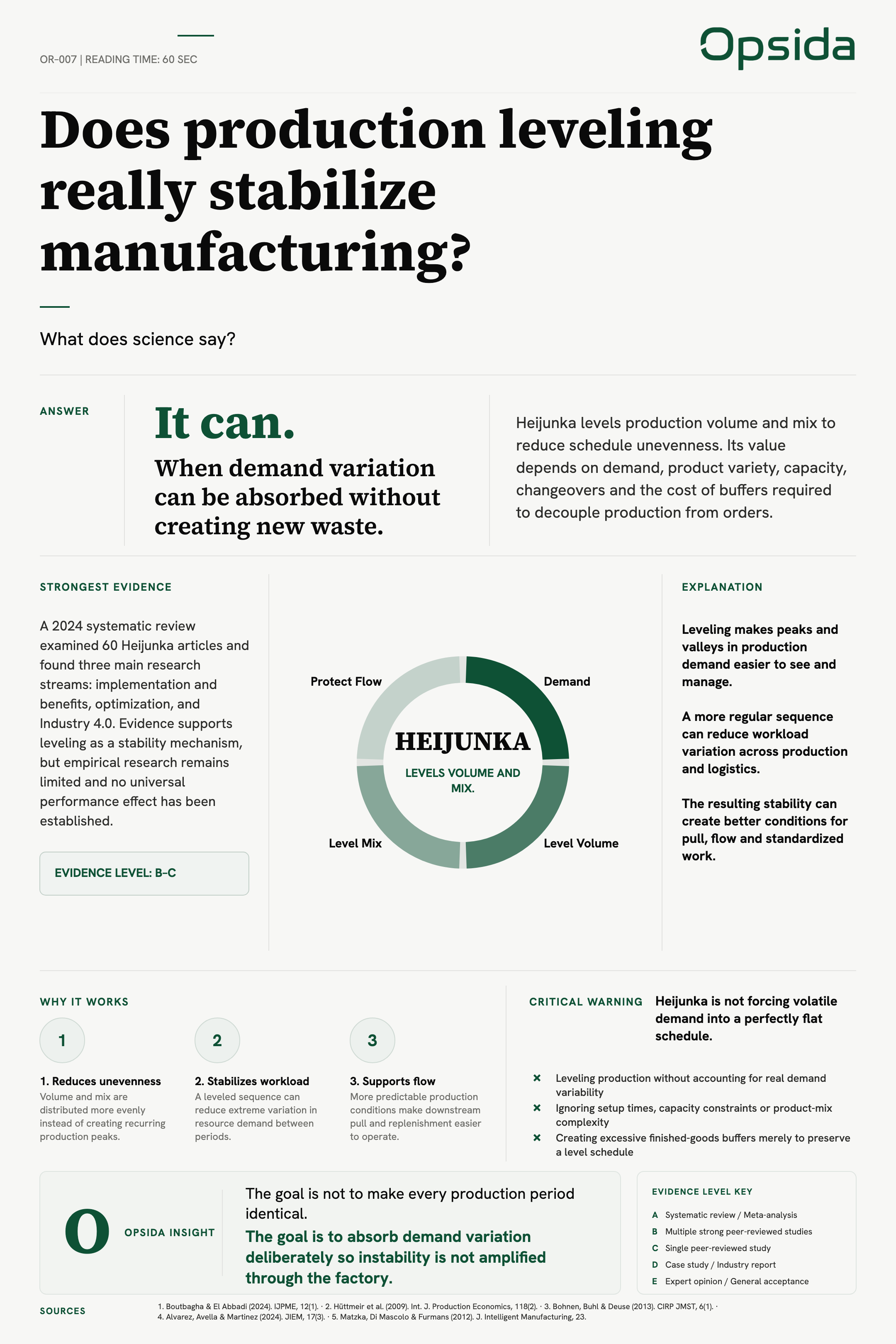
HEIJUNKA levels volume and mix.
- DemandUnderstand demand volume, mix and variability before choosing the leveling horizon.
- Level VolumeDistribute production load more evenly across available time and capacity.
- Level MixSequence product families to avoid large batches and extreme workload variation.
- Protect FlowUse appropriate buffers and replenishment rules to separate customer variation from production.
Explanation
- Leveling makes peaks and valleys in production demand easier to see and manage.
- A more regular sequence can reduce workload variation across production and logistics.
- The resulting stability can create better conditions for pull, flow and standardized work.
Why it works
Reduces unevenness
Volume and mix are distributed more evenly instead of creating recurring production peaks.
Stabilizes workload
A leveled sequence can reduce extreme variation in resource demand between periods.
Supports flow
More predictable production conditions make downstream pull and replenishment easier to operate.
Critical warning
Heijunka is not forcing volatile demand into a perfectly flat schedule.
- Leveling production without accounting for real demand variability
- Ignoring setup times, capacity constraints or product-mix complexity
- Creating excessive finished-goods buffers merely to preserve a level schedule
Opsida insight
The goal is not to make every production period identical.
The goal is to absorb demand variation deliberately so instability is not amplified through the factory.
Sources
Boutbagha, M., & El Abbadi, L. (2024). Heijunka-levelling customer orders: A systematic literature review. International Journal of Production Management and Engineering, 12(1), 31–41.
Hüttmeir, A., de Treville, S., van Ackere, A., Monnier, L., & Prenninger, J. (2009). Trading off between heijunka and just-in-sequence. International Journal of Production Economics, 118(2), 501–507.
Bohnen, F., Buhl, M., & Deuse, J. (2013). Systematic procedure for leveling of low volume and high mix production. CIRP Journal of Manufacturing Science and Technology, 6(1), 53–58.
Alvarez, L., Avella, L., & Martinez, R. (2024). Impact and critical factors in Heijunka implementation: An action research study. Journal of Industrial Engineering and Management, 17(3), 753–776.
Matzka, J., Di Mascolo, M., & Furmans, K. (2012). Buffer sizing of a Heijunka Kanban system. Journal of Intelligent Manufacturing, 23, 49–60.
Evidence level key
- A
- Systematic review / Meta-analysis
- B
- Multiple strong peer-reviewed studies
- C
- Single peer-reviewed study
- D
- Case study / Industry report
- E
- Expert opinion / General acceptance
Poster
The full issue as a single sheet — the same content, laid out for printing and sharing.