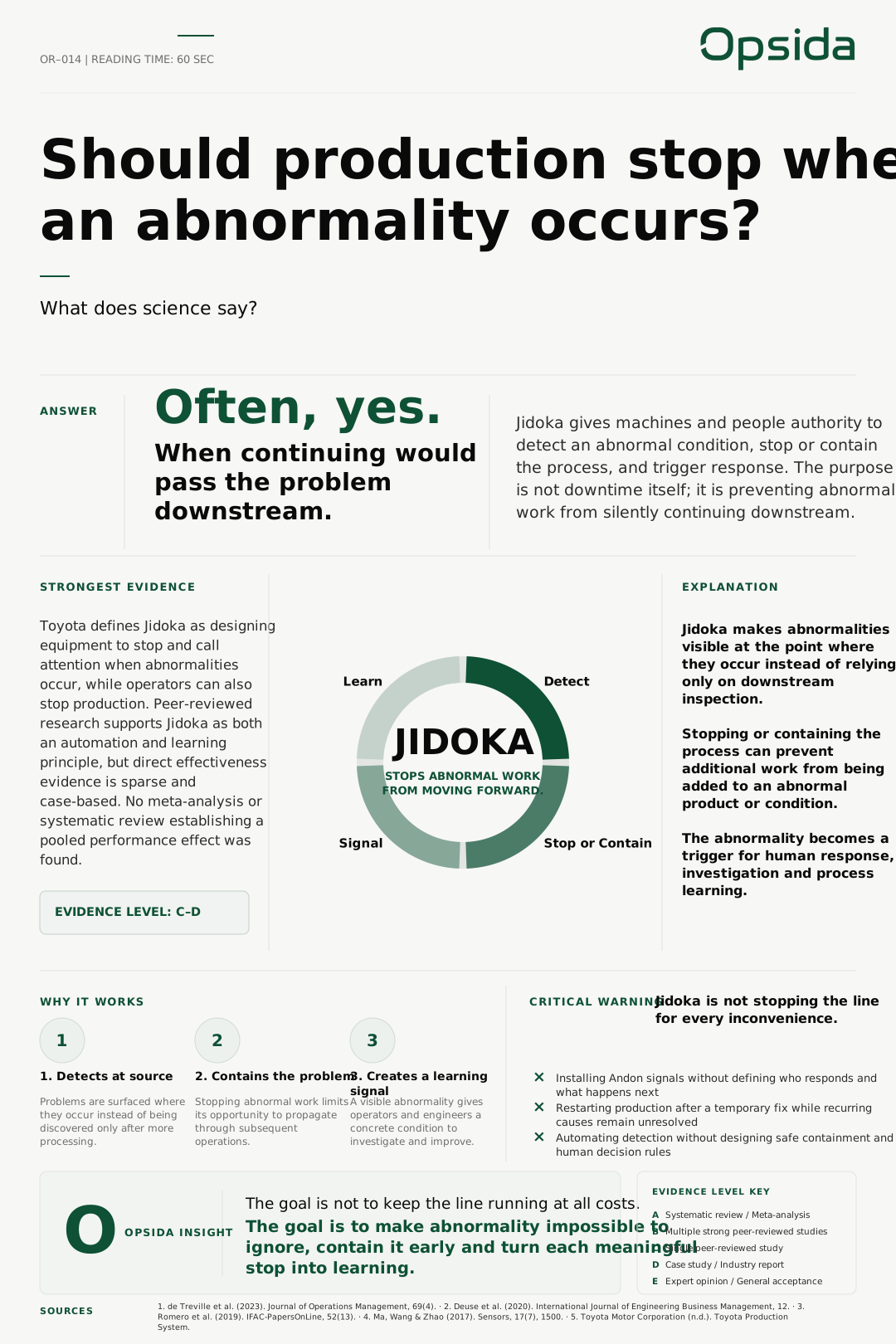
Should production stop when an abnormality occurs?
What does science say?
Answer
Often, yes.
When continuing would pass the problem downstream.
Jidoka gives machines and people authority to detect an abnormal condition, stop or contain the process, and trigger response. The purpose is not downtime itself; it is preventing abnormal work from silently continuing downstream.
Strongest evidence
Toyota defines Jidoka as designing equipment to stop and call attention when abnormalities occur, while operators can also stop production. Peer-reviewed research supports Jidoka as both an automation and learning principle, but direct effectiveness evidence is sparse and case-based. No meta-analysis or systematic review establishing a pooled performance effect was found.
The steps, in order
JIDOKA stops abnormal work from moving forward.
- DetectRecognize an abnormal condition at the machine, process or operator level.
- Stop or ContainPrevent abnormal work from continuing until the immediate condition is controlled.
- SignalMake the abnormality visible so the responsible person can respond quickly.
- LearnInvestigate recurring problems and improve the process so the abnormality is less likely to return.
Explanation
- Jidoka makes abnormalities visible at the point where they occur instead of relying only on downstream inspection.
- Stopping or containing the process can prevent additional work from being added to an abnormal product or condition.
- The abnormality becomes a trigger for human response, investigation and process learning.
Why it works
Detects at source
Problems are surfaced where they occur instead of being discovered only after more processing.
Contains the problem
Stopping abnormal work limits its opportunity to propagate through subsequent operations.
Creates a learning signal
A visible abnormality gives operators and engineers a concrete condition to investigate and improve.
Critical warning
Jidoka is not stopping the line for every inconvenience.
- Installing Andon signals without defining who responds and what happens next
- Restarting production after a temporary fix while recurring causes remain unresolved
- Automating detection without designing safe containment and human decision rules
Opsida insight
The goal is not to keep the line running at all costs.
The goal is to make abnormality impossible to ignore, contain it early and turn each meaningful stop into learning.
Sources
de Treville, S., Browning, T. R., Marewski, J. N., & Weiss, J. (2023). Editorial: Toyota Production System practices as Fast-and-Frugal heuristics. Journal of Operations Management, 69(4), 522–535.
Deuse, J., Dombrowski, U., Nöhring, F., Mazarov, J., & Dix, Y. (2020). Systematic combination of Lean Management with digitalization to improve production systems on the example of Jidoka 4.0. International Journal of Engineering Business Management, 12, 1–9.
Romero, D., Gaiardelli, P., Powell, D., Wuest, T., & Thürer, M. (2019). Rethinking Jidoka systems under automation & learning perspectives in the digital lean manufacturing world. IFAC-PapersOnLine, 52(13), 899–903.
Ma, J., Wang, Q., & Zhao, Z. (2017). SLAE–CPS: Smart Lean Automation Engine Enabled by Cyber-Physical Systems Technologies. Sensors, 17(7), 1500.
Toyota Motor Corporation. (n.d.). Toyota Production System. Toyota Motor Corporation Official Global Website.
Evidence level key
- A
- Systematic review / Meta-analysis
- B
- Multiple strong peer-reviewed studies
- C
- Single peer-reviewed study
- D
- Case study / Industry report
- E
- Expert opinion / General acceptance
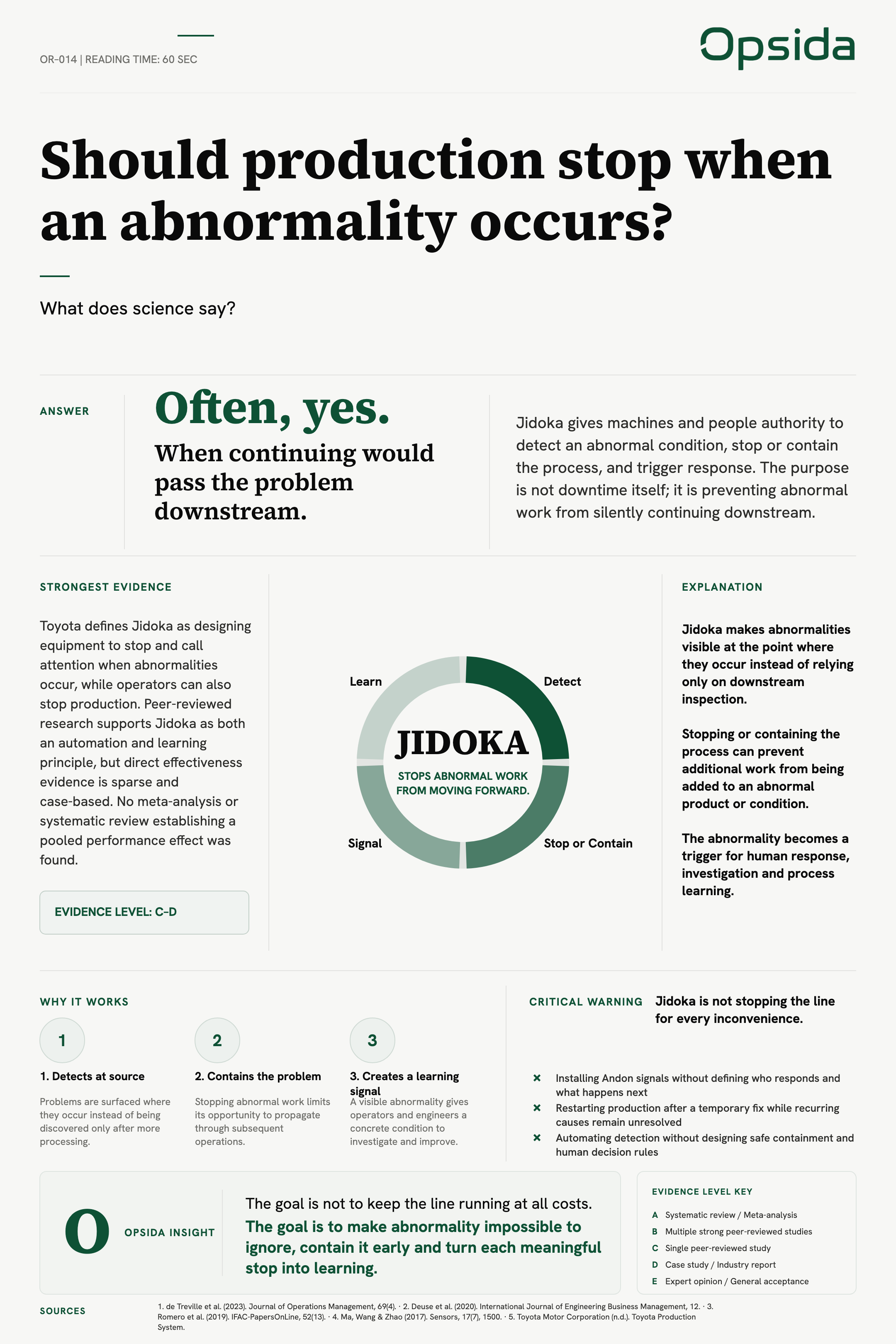
Poster
The full issue as a single sheet — the same content, laid out for printing and sharing.