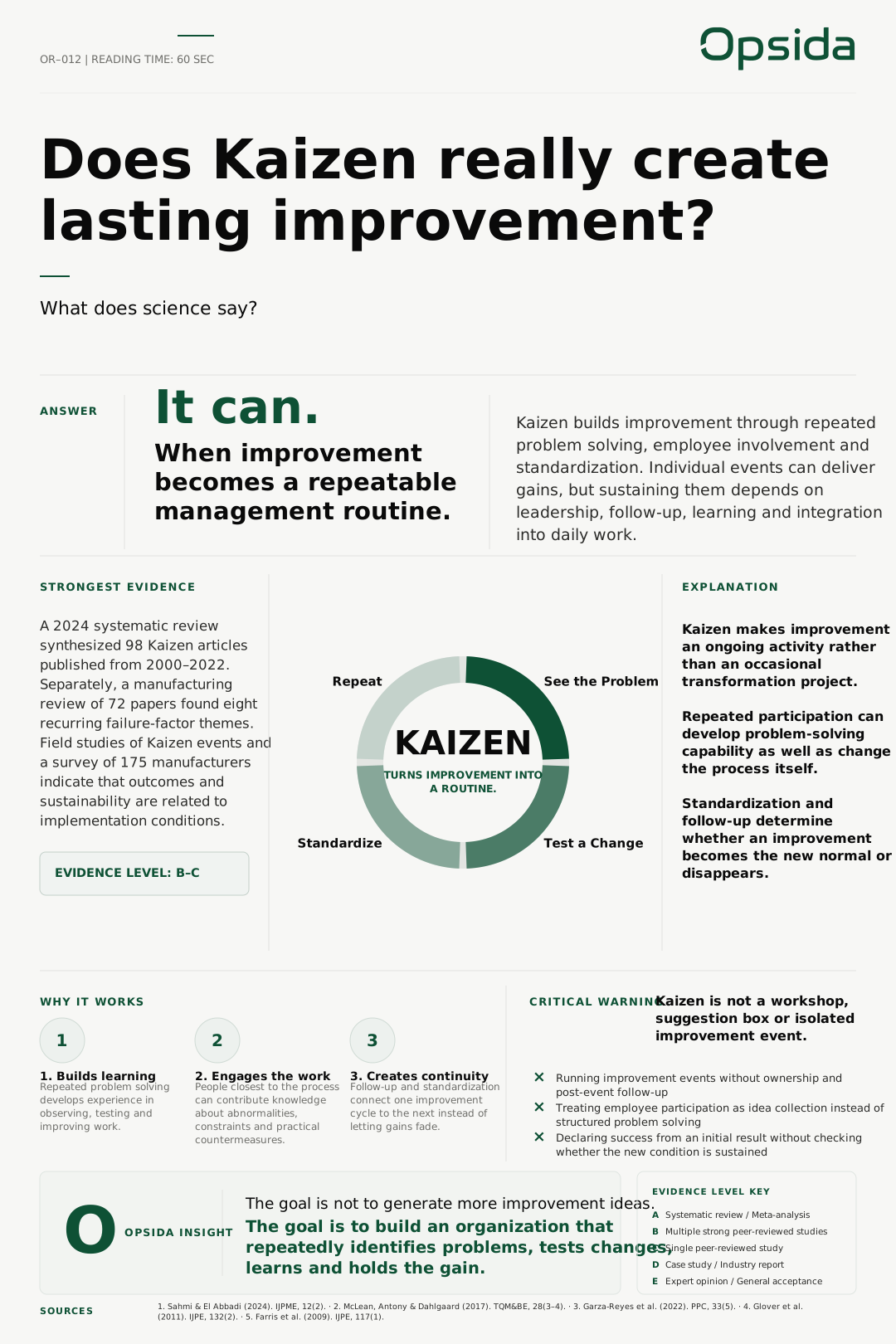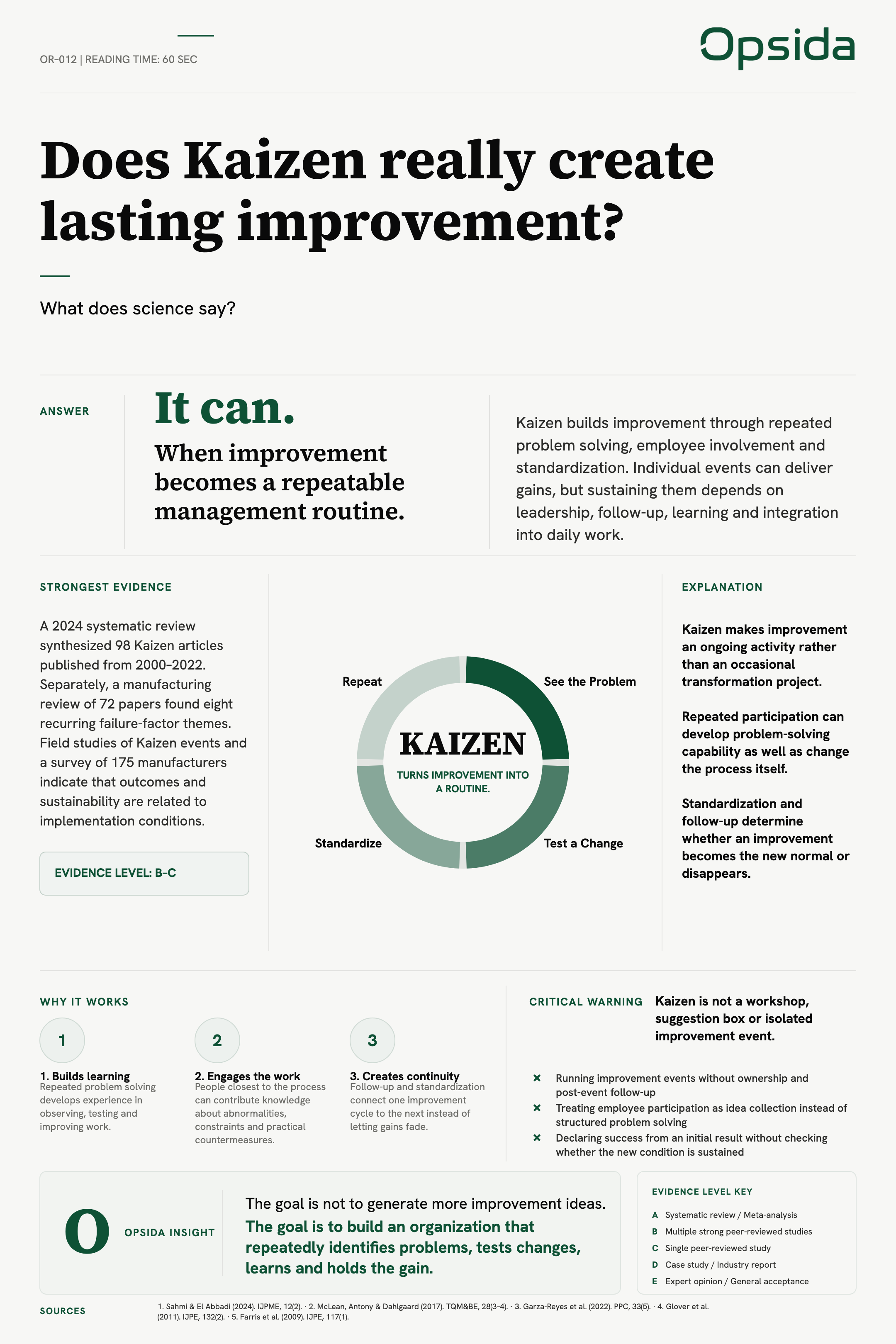
Does Kaizen really create lasting improvement?
What does science say?
Answer
It can.
When improvement becomes a repeatable management routine.
Kaizen builds improvement through repeated problem solving, employee involvement and standardization. Individual events can deliver gains, but sustaining them depends on leadership, follow-up, learning and integration into daily work.
Strongest evidence
A 2024 systematic review synthesized 98 Kaizen articles published from 2000–2022. Separately, a manufacturing review of 72 papers found eight recurring failure-factor themes. Field studies of Kaizen events and a survey of 175 manufacturers indicate that outcomes and sustainability are related to implementation conditions.
98Kaizen research articles reviewed2000–2022 · 2024 systematic literature review · Systematic literature review; not an effectiveness sample
The steps, in order
KAIZEN turns improvement into a routine.
- See the ProblemUse actual work, data and observation to define a specific gap from the expected condition.
- Test a ChangeDevelop and test a practical countermeasure instead of treating the first idea as the answer.
- StandardizeWhen the change works, incorporate the new method into the way the process is operated.
- RepeatUse the new condition as the starting point for the next cycle of problem solving and learning.
Explanation
- Kaizen makes improvement an ongoing activity rather than an occasional transformation project.
- Repeated participation can develop problem-solving capability as well as change the process itself.
- Standardization and follow-up determine whether an improvement becomes the new normal or disappears.
Why it works
Builds learning
Repeated problem solving develops experience in observing, testing and improving work.
Engages the work
People closest to the process can contribute knowledge about abnormalities, constraints and practical countermeasures.
Creates continuity
Follow-up and standardization connect one improvement cycle to the next instead of letting gains fade.
Critical warning
Kaizen is not a workshop, suggestion box or isolated improvement event.
- Running improvement events without ownership and post-event follow-up
- Treating employee participation as idea collection instead of structured problem solving
- Declaring success from an initial result without checking whether the new condition is sustained
Opsida insight
The goal is not to generate more improvement ideas.
The goal is to build an organization that repeatedly identifies problems, tests changes, learns and holds the gain.
Sources
Sahmi, Z., & El Abbadi, L. (2024). The evolution of Kaizen in the industry: Systematic literature review. International Journal of Production Management and Engineering, 12(2), 169–179.
McLean, R. S., Antony, J., & Dahlgaard, J. J. (2017). Failure of Continuous Improvement initiatives in manufacturing environments: A systematic review of the evidence. Total Quality Management & Business Excellence, 28(3–4), 219–237.
Garza-Reyes, J. A., Christopoulos, C., Kumar, A., Luthra, S., González-Aleu, F., Kumar, V., & Villarreal, B. (2022). Deploying Kaizen events in the manufacturing industry: An investigation into managerial factors. Production Planning & Control, 33(5), 427–449.
Glover, W. J., Farris, J. A., Van Aken, E. M., & Doolen, T. L. (2011). Critical success factors for the sustainability of Kaizen event human resource outcomes: An empirical study. International Journal of Production Economics, 132(2), 197–213.
Farris, J. A., Van Aken, E. M., Doolen, T. L., & Worley, J. (2009). Critical success factors for human resource outcomes in Kaizen events: An empirical study. International Journal of Production Economics, 117(1), 42–65.
Evidence level key
- A
- Systematic review / Meta-analysis
- B
- Multiple strong peer-reviewed studies
- C
- Single peer-reviewed study
- D
- Case study / Industry report
- E
- Expert opinion / General acceptance
Poster
The full issue as a single sheet — the same content, laid out for printing and sharing.