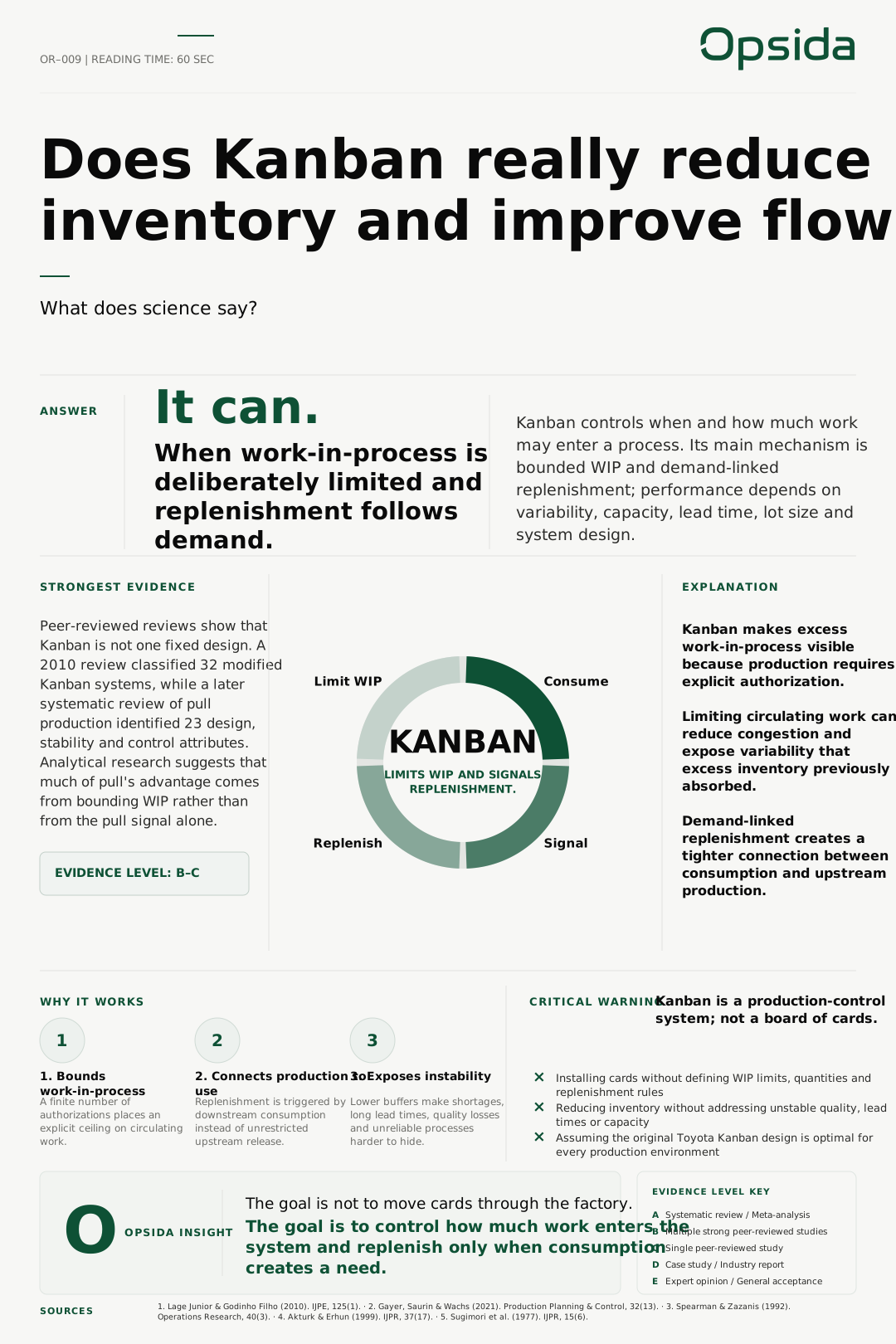
Does Kanban really reduce inventory and improve flow?
What does science say?
Answer
It can.
When work-in-process is deliberately limited and replenishment follows demand.
Kanban controls when and how much work may enter a process. Its main mechanism is bounded WIP and demand-linked replenishment; performance depends on variability, capacity, lead time, lot size and system design.
Strongest evidence
Peer-reviewed reviews show that Kanban is not one fixed design. A 2010 review classified 32 modified Kanban systems, while a later systematic review of pull production identified 23 design, stability and control attributes. Analytical research suggests that much of pull's advantage comes from bounding WIP rather than from the pull signal alone.
32modified Kanban systems reviewed2010 peer-reviewed literature review · Kanban-system variations; not an effectiveness sample
The steps, in order
KANBAN limits wip and signals replenishment.
- ConsumeDownstream use creates the need for replenishment rather than a forecast alone.
- SignalA card, container or digital signal authorizes a defined replenishment quantity.
- ReplenishUpstream production replaces authorized consumption instead of producing without a limit.
- Limit WIPThe number and size of Kanbans constrain how much material or work can circulate.
Explanation
- Kanban makes excess work-in-process visible because production requires explicit authorization.
- Limiting circulating work can reduce congestion and expose variability that excess inventory previously absorbed.
- Demand-linked replenishment creates a tighter connection between consumption and upstream production.
Why it works
Bounds work-in-process
A finite number of authorizations places an explicit ceiling on circulating work.
Connects production to use
Replenishment is triggered by downstream consumption instead of unrestricted upstream release.
Exposes instability
Lower buffers make shortages, long lead times, quality losses and unreliable processes harder to hide.
Critical warning
Kanban is a production-control system; not a board of cards.
- Installing cards without defining WIP limits, quantities and replenishment rules
- Reducing inventory without addressing unstable quality, lead times or capacity
- Assuming the original Toyota Kanban design is optimal for every production environment
Opsida insight
The goal is not to move cards through the factory.
The goal is to control how much work enters the system and replenish only when consumption creates a need.
Sources
Lage Junior, M., & Godinho Filho, M. (2010). Variations of the kanban system: Literature review and classification. International Journal of Production Economics, 125(1), 13–21.
Gayer, B. D., Saurin, T. A., & Wachs, P. (2021). A method for assessing pull production systems: A study of manufacturing, healthcare, and construction. Production Planning & Control, 32(13), 1063–1083.
Spearman, M. L., & Zazanis, M. A. (1992). Push and pull production systems: Issues and comparisons. Operations Research, 40(3), 521–532.
Akturk, M. S., & Erhun, F. (1999). An overview of design and operational issues of kanban systems. International Journal of Production Research, 37(17), 3859–3881.
Sugimori, Y., Kusunoki, K., Cho, F., & Uchikawa, S. (1977). Toyota production system and Kanban system: Materialization of just-in-time and respect-for-human system. International Journal of Production Research, 15(6), 553–564.
Evidence level key
- A
- Systematic review / Meta-analysis
- B
- Multiple strong peer-reviewed studies
- C
- Single peer-reviewed study
- D
- Case study / Industry report
- E
- Expert opinion / General acceptance
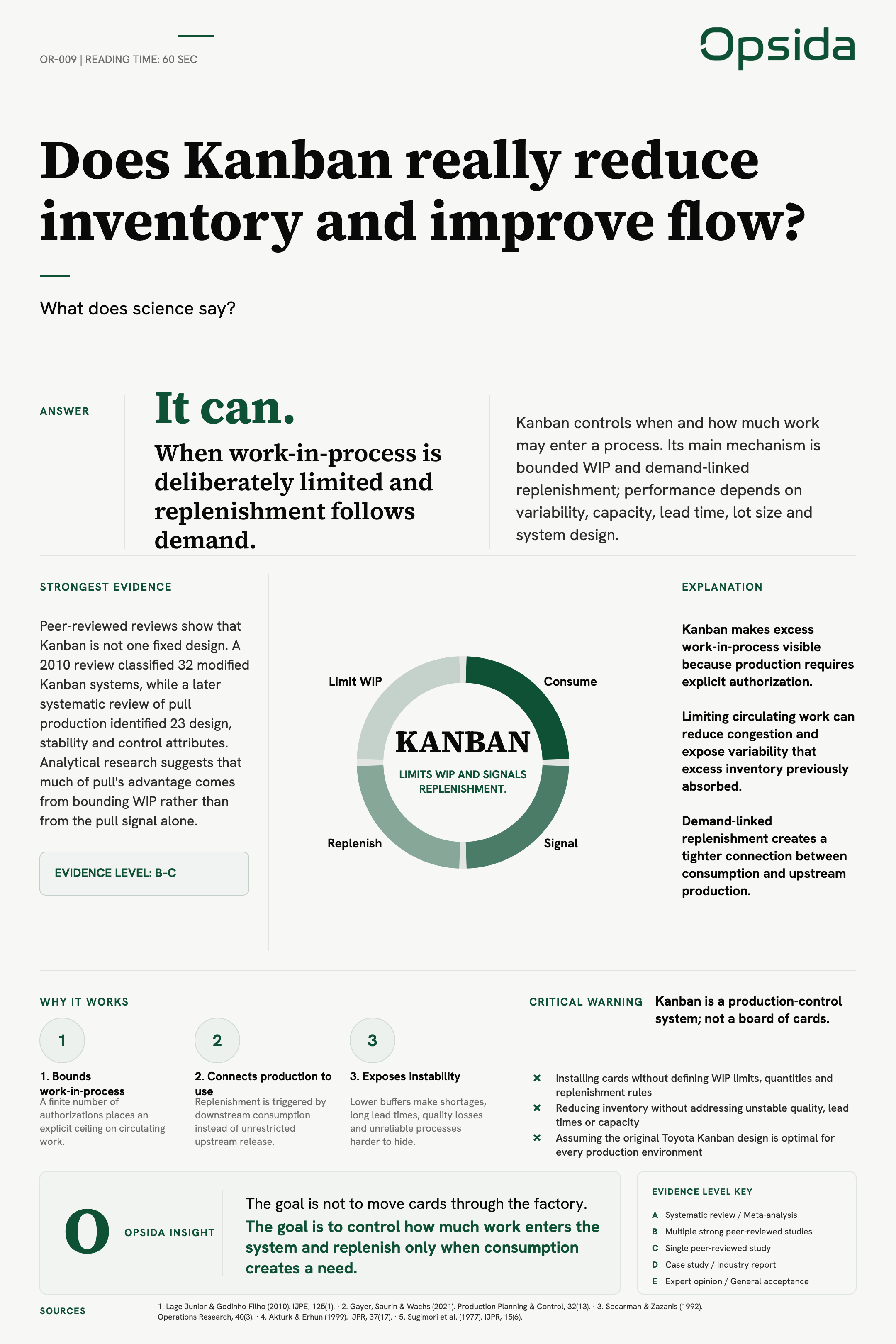
Poster
The full issue as a single sheet — the same content, laid out for printing and sharing.