Does Lean automatically make work safer?
What does science say?
Answer
No.
Ergonomics must be designed into improvement.
Lean can improve production performance without necessarily improving working conditions. Removing wasted motion may reduce physical strain, but increasing pace or repetition without redesigning work can increase ergonomic risks. Sustainable improvement requires evaluating productivity and human workload together.
Strongest evidence
A 2018 systematic review identified 73 empirical manufacturing studies linking human factors with production quality. A separate review of 36 studies found mostly negative health outcomes associated with Lean implementation, with some mixed and positive examples. A systematic review of 18 garment-industry studies found positive productivity associations but less consistent occupational health and safety findings. No universal causal effect was established.
73manufacturing human-factors studies reviewed2018 systematic review · Human factors and production quality · Systematic review corpus; not exclusively Lean studies and not an effectiveness estimate
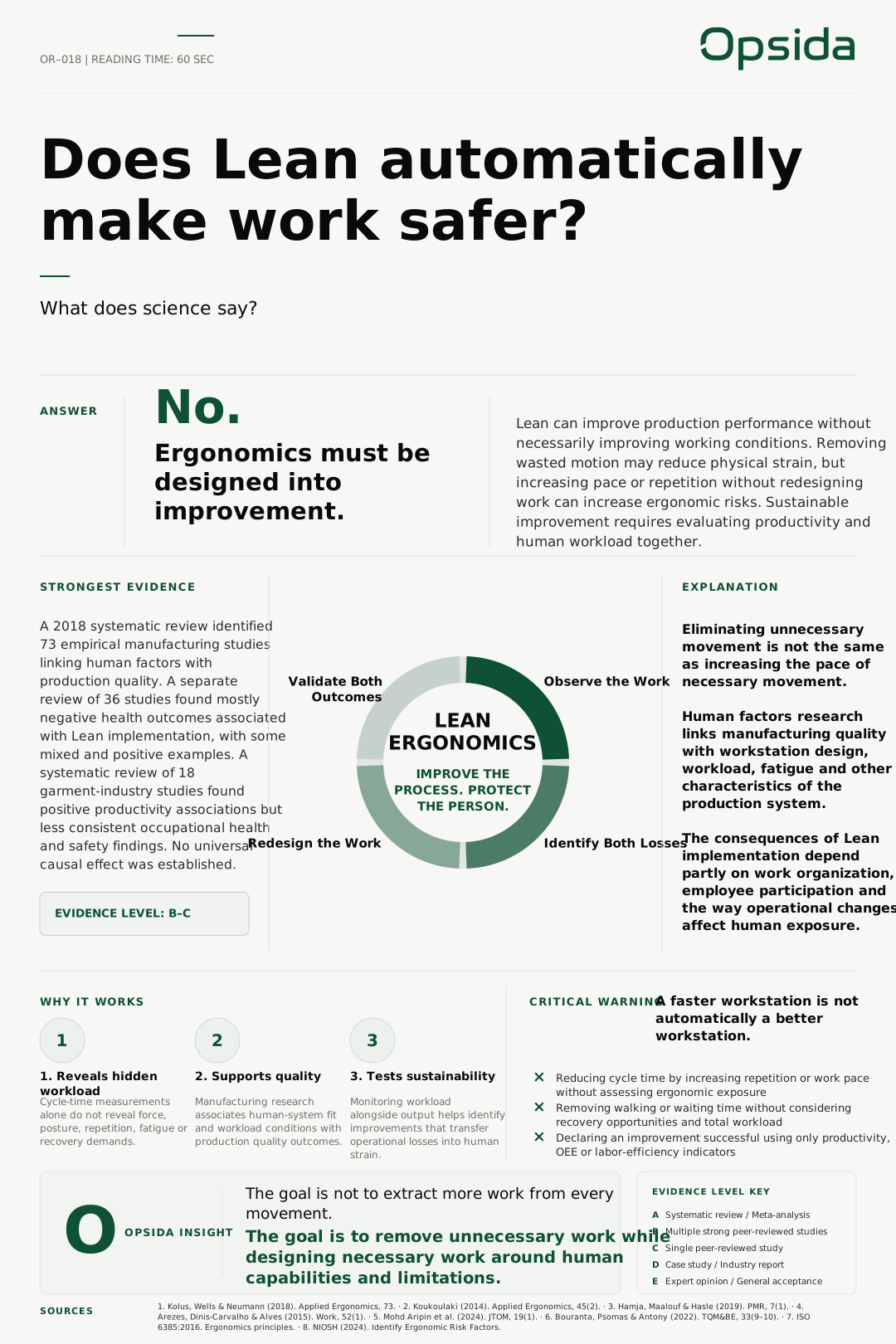
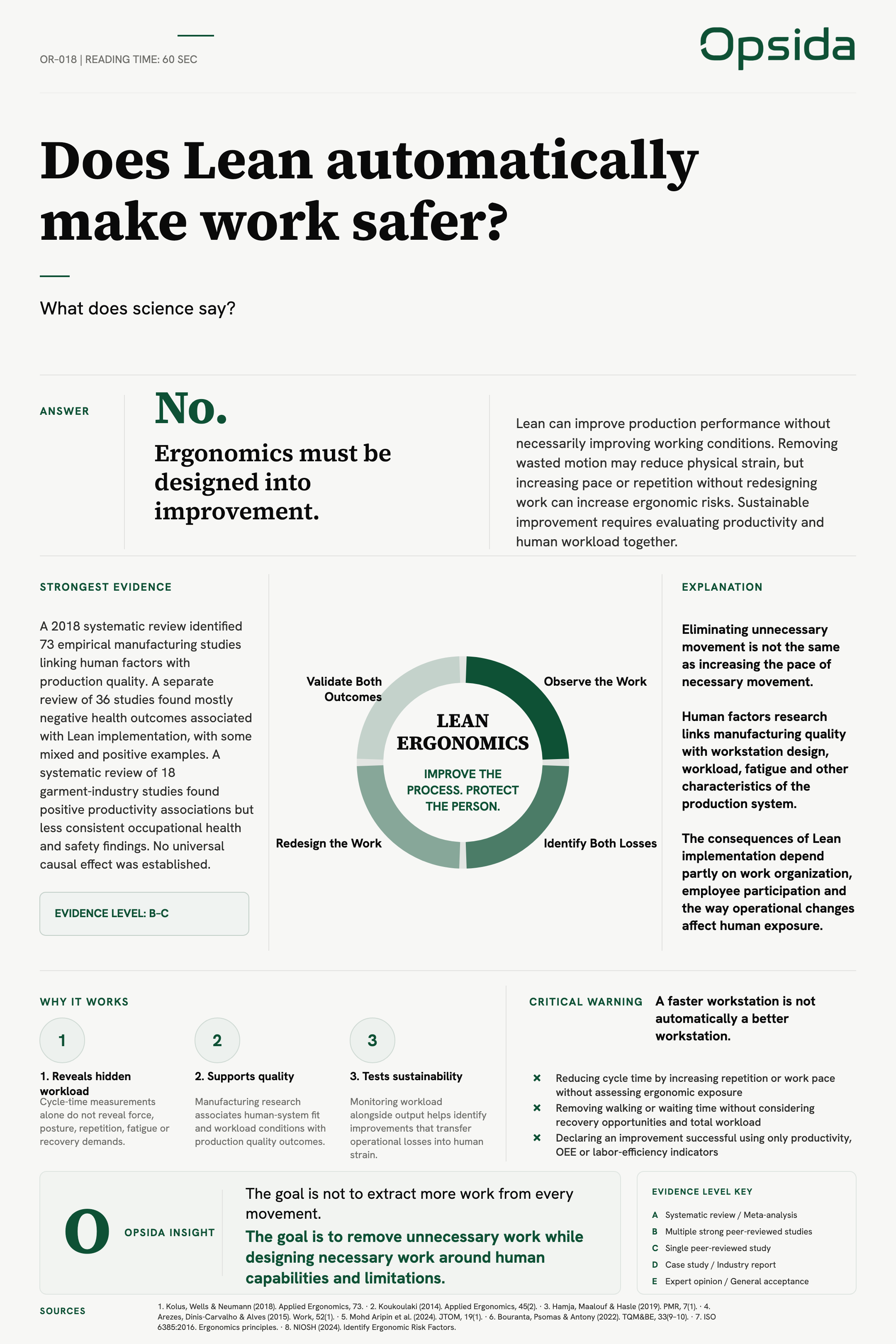
The steps, in order
LEAN ERGONOMICS improve the process. protect the person.
- Observe the WorkExamine actual movements, postures, forces, repetition, pace and recovery opportunities.
- Identify Both LossesIdentify process waste alongside physical and psychosocial workload risks.
- Redesign the WorkImprove workstation design, handling methods, task allocation and work organization.
- Validate Both OutcomesMeasure operational performance and ergonomic exposure before and after the change.
Explanation
- Eliminating unnecessary movement is not the same as increasing the pace of necessary movement.
- Human factors research links manufacturing quality with workstation design, workload, fatigue and other characteristics of the production system.
- The consequences of Lean implementation depend partly on work organization, employee participation and the way operational changes affect human exposure.
Why it works
Reveals hidden workload
Cycle-time measurements alone do not reveal force, posture, repetition, fatigue or recovery demands.
Supports quality
Manufacturing research associates human-system fit and workload conditions with production quality outcomes.
Tests sustainability
Monitoring workload alongside output helps identify improvements that transfer operational losses into human strain.
Critical warning
A faster workstation is not automatically a better workstation.
- Reducing cycle time by increasing repetition or work pace without assessing ergonomic exposure
- Removing walking or waiting time without considering recovery opportunities and total workload
- Declaring an improvement successful using only productivity, OEE or labor-efficiency indicators
Opsida insight
The goal is not to extract more work from every movement.
The goal is to remove unnecessary work while designing necessary work around human capabilities and limitations.
Sources
Kolus, A., Wells, R., & Neumann, P. (2018). Production quality and human factors engineering: A systematic review and theoretical framework. Applied Ergonomics, 73, 55–89.
Koukoulaki, T. (2014). The impact of lean production on musculoskeletal and psychosocial risks: An examination of sociotechnical trends over 20 years. Applied Ergonomics, 45(2), 198–212.
Hamja, A., Maalouf, M., & Hasle, P. (2019). The effect of lean on occupational health and safety and productivity in the garment industry – a literature review. Production & Manufacturing Research, 7(1), 316–334.
Arezes, P. M., Dinis-Carvalho, J., & Alves, A. C. (2015). Workplace ergonomics in lean production environments: A literature review. Work, 52(1), 57–70.
Mohd Aripin, N., Mahmud, F., Lee, K. L., & Hussain, S. (2024). Systematic Literature Review: Lean Ergonomics Analysis in Small & Medium Enterprises (SMEs) Manufacturing Sector. Journal of Technology and Operations Management, 19(1), 89–108.
Bouranta, N., Psomas, E., & Antony, J. (2022). Human factors involved in lean management: A systematic literature review. Total Quality Management & Business Excellence, 33(9–10), 1113–1145.
International Organization for Standardization. (2016). ISO 6385:2016 — Ergonomics principles in the design of work systems. Third edition.
National Institute for Occupational Safety and Health. (2024). Step 1: Identify Risk Factors. Ergonomics Programs. Centers for Disease Control and Prevention.
Evidence level key
- A
- Systematic review / Meta-analysis
- B
- Multiple strong peer-reviewed studies
- C
- Single peer-reviewed study
- D
- Case study / Industry report
- E
- Expert opinion / General acceptance
Poster
The full issue as a single sheet — the same content, laid out for printing and sharing.