Does OEE really improve production performance?
What does science say?
Answer
No.
Not on its own.
OEE creates value when it makes losses visible and is connected to a systematic improvement process.
Strongest evidence
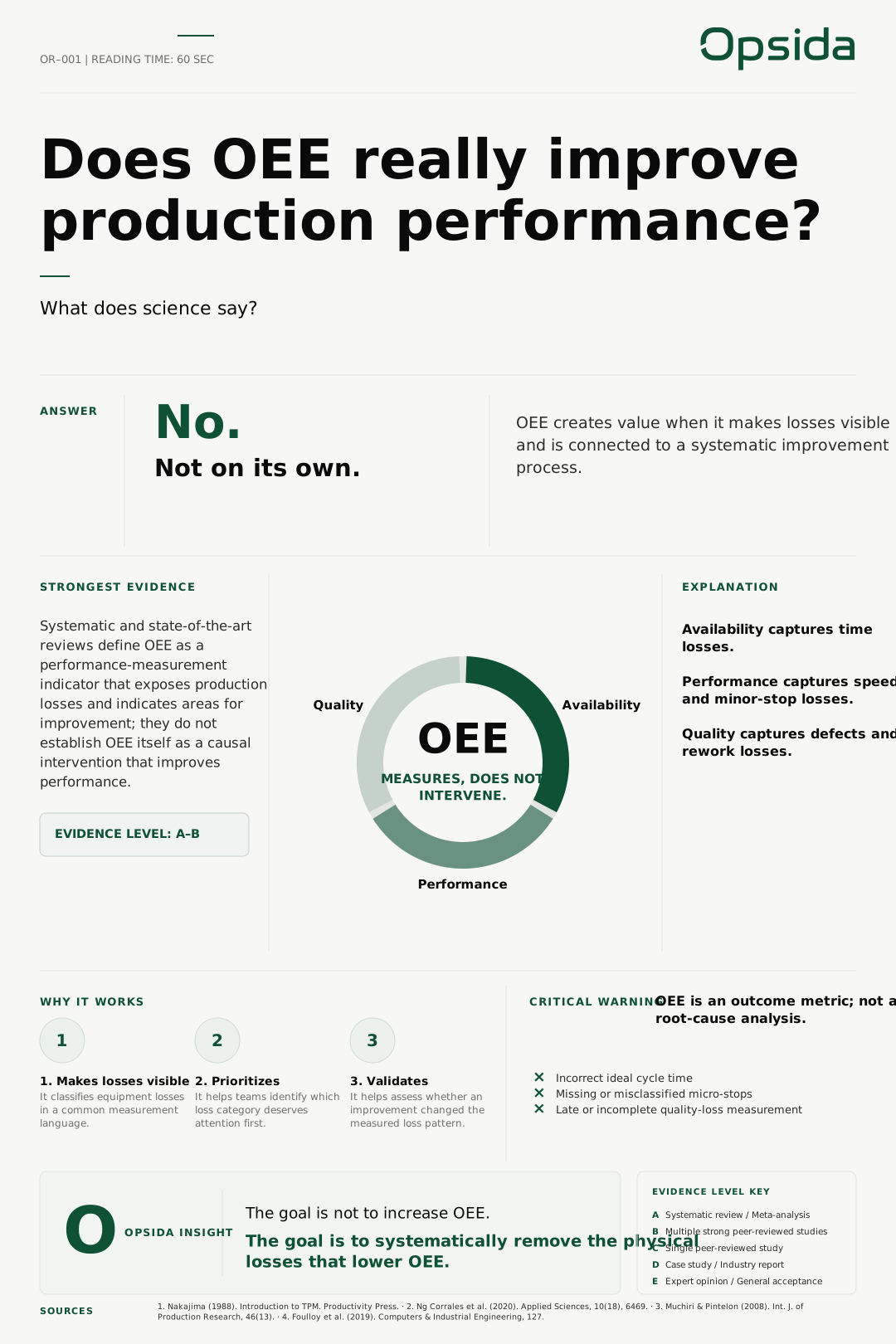
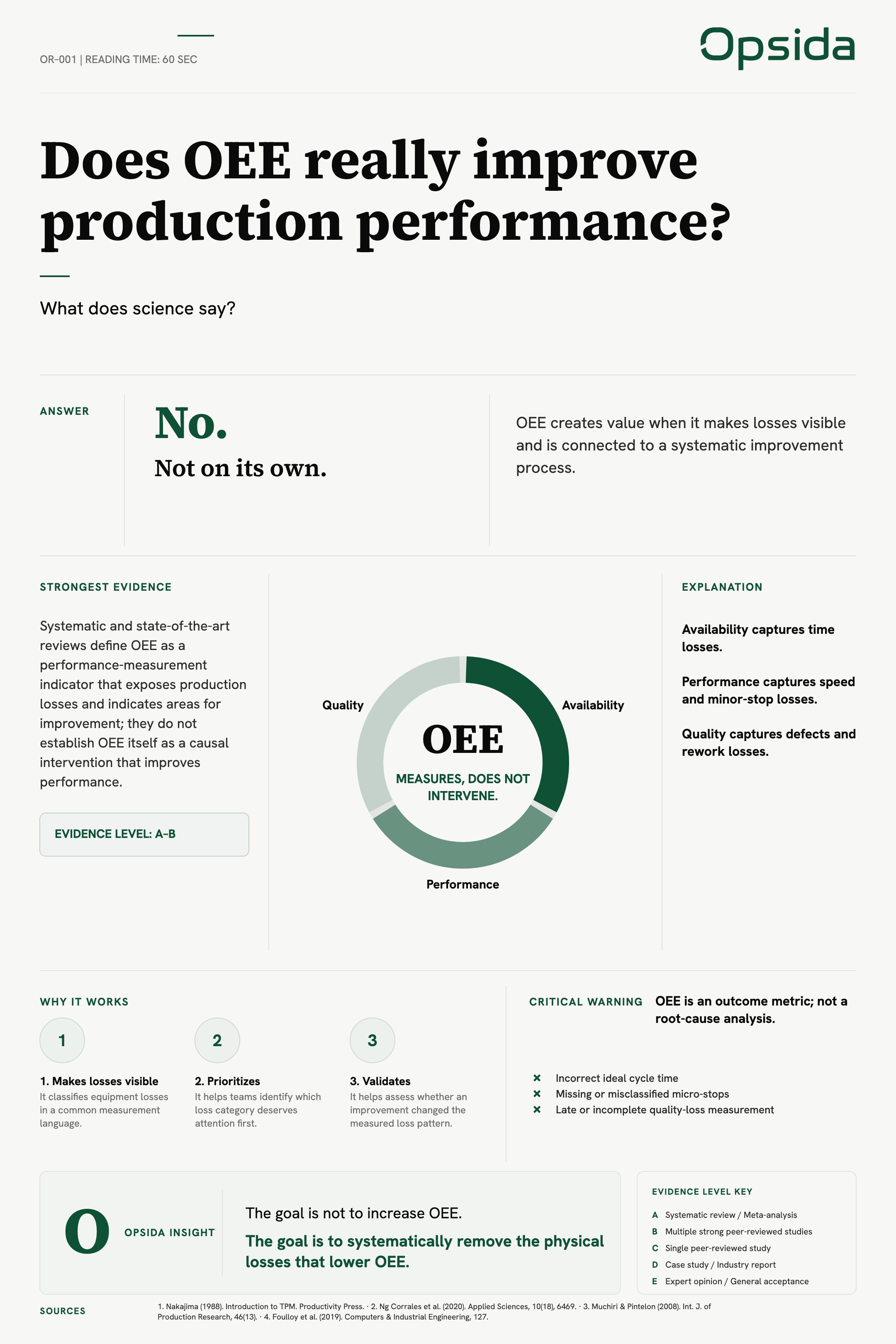
Systematic and state-of-the-art reviews define OEE as a performance-measurement indicator that exposes production losses and indicates areas for improvement; they do not establish OEE itself as a causal intervention that improves performance.
The factors, multiplied
OEE measures, does not intervene.
- AvailabilityThe proportion of planned production time that is actually available.
- PerformanceHow close actual operating speed is to the theoretical or ideal speed.
- QualityThe proportion of good units out of total units produced.
Explanation
- Availability captures time losses.
- Performance captures speed and minor-stop losses.
- Quality captures defects and rework losses.
Why it works
Makes losses visible
It classifies equipment losses in a common measurement language.
Prioritizes
It helps teams identify which loss category deserves attention first.
Validates
It helps assess whether an improvement changed the measured loss pattern.
Critical warning
OEE is an outcome metric; not a root-cause analysis.
- Incorrect ideal cycle time
- Missing or misclassified micro-stops
- Late or incomplete quality-loss measurement
Opsida insight
The goal is not to increase OEE.
The goal is to systematically remove the physical losses that lower OEE.
Sources
Nakajima, S. (1988). Introduction to TPM: Total Productive Maintenance. Productivity Press.
Ng Corrales, L. del C., Lambán, M. P., Hernandez Korner, M. E., & Royo, J. (2020). Overall Equipment Effectiveness: Systematic Literature Review and Overview of Different Approaches. Applied Sciences, 10(18), 6469.
Muchiri, P., & Pintelon, L. (2008). Performance measurement using overall equipment effectiveness (OEE): literature review and practical application discussion. International Journal of Production Research, 46(13), 3517–3535.
Foulloy, L., Clivillé, V., & Berrah, L. (2019). A fuzzy temporal approach to the Overall Equipment Effectiveness measurement. Computers & Industrial Engineering, 127, 103–115.
Evidence level key
- A
- Systematic review / Meta-analysis
- B
- Multiple strong peer-reviewed studies
- C
- Single peer-reviewed study
- D
- Case study / Industry report
- E
- Expert opinion / General acceptance
Poster
The full issue as a single sheet — the same content, laid out for printing and sharing.