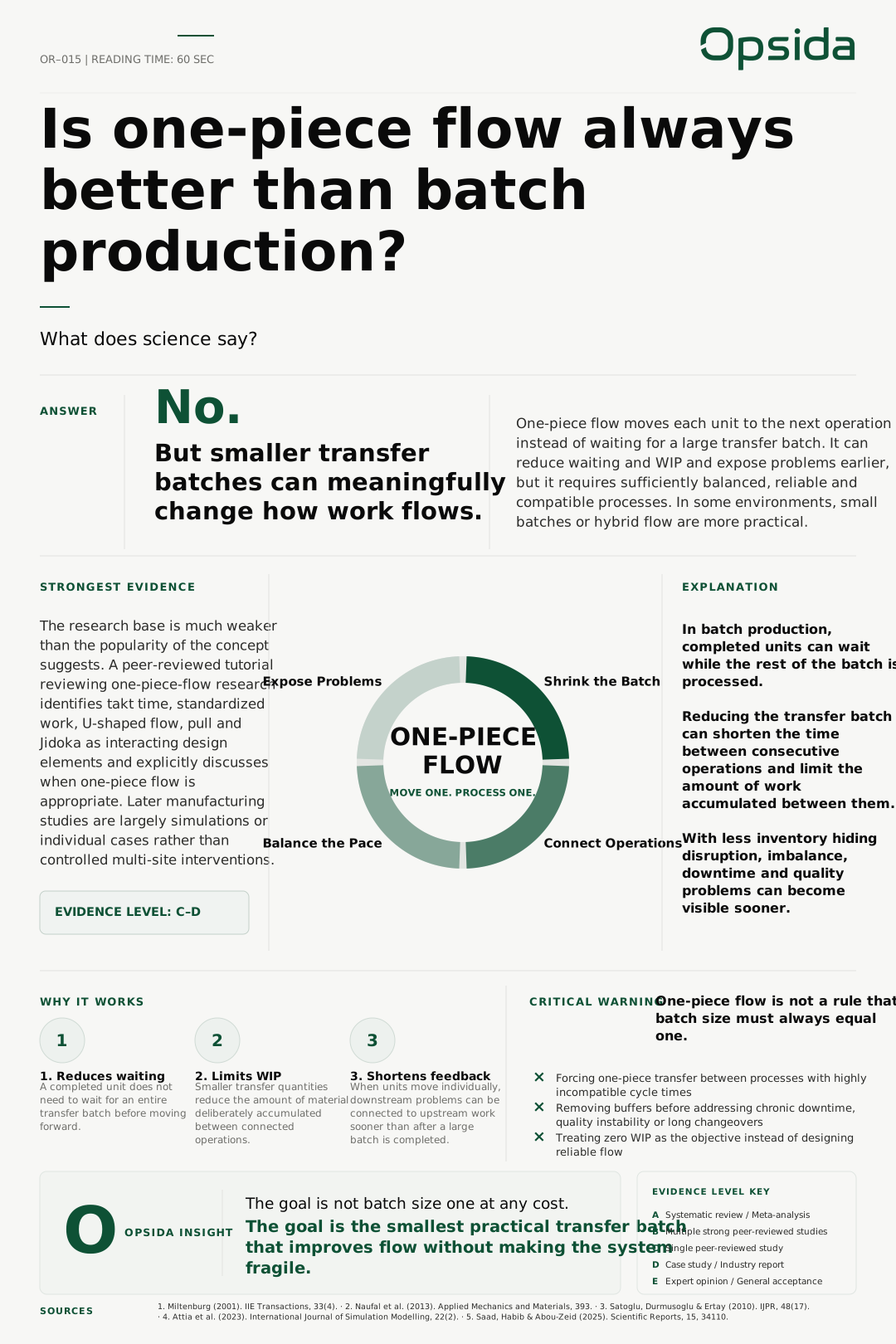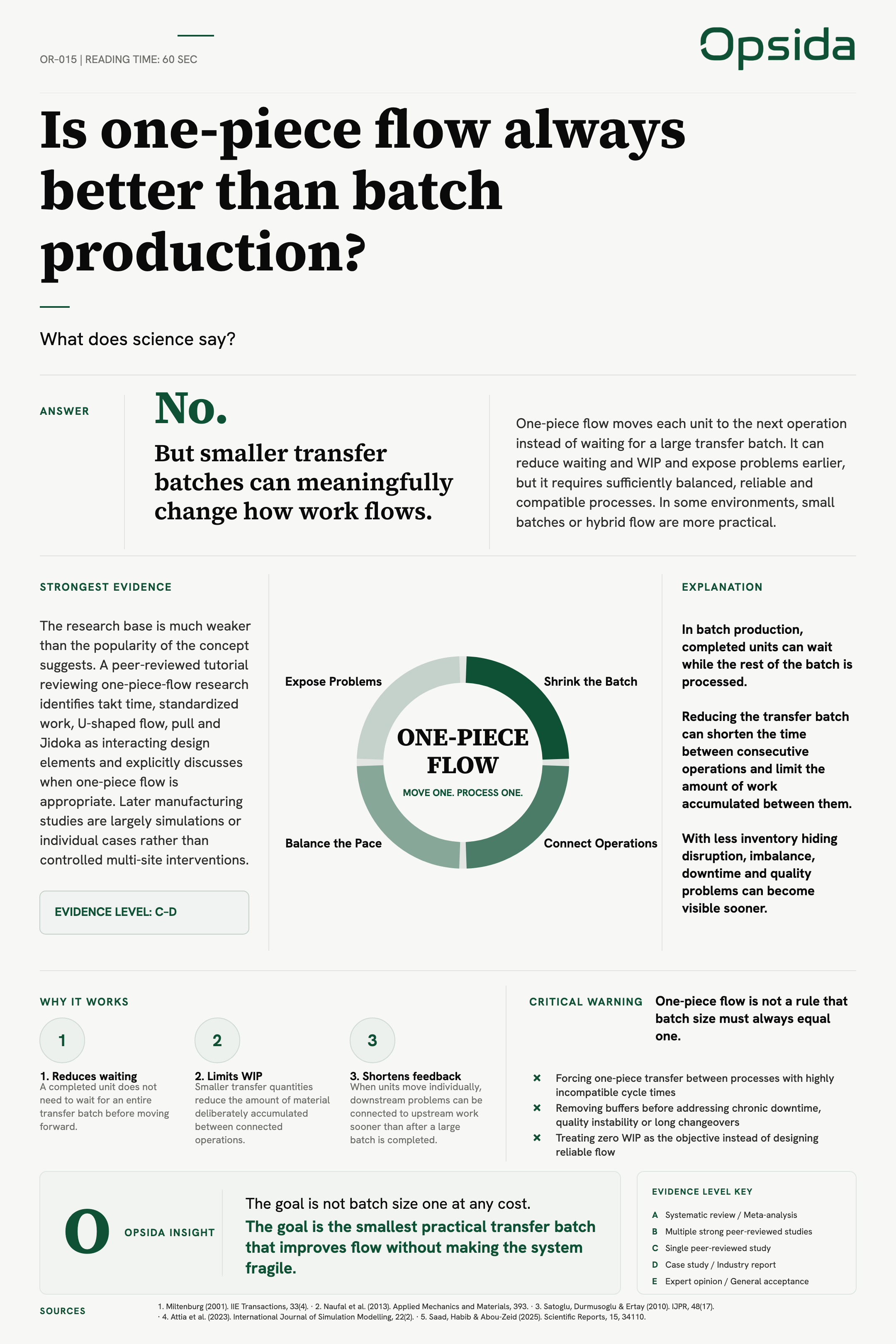
Is one-piece flow always better than batch production?
What does science say?
Answer
No.
But smaller transfer batches can meaningfully change how work flows.
One-piece flow moves each unit to the next operation instead of waiting for a large transfer batch. It can reduce waiting and WIP and expose problems earlier, but it requires sufficiently balanced, reliable and compatible processes. In some environments, small batches or hybrid flow are more practical.
Strongest evidence
The research base is much weaker than the popularity of the concept suggests. A peer-reviewed tutorial reviewing one-piece-flow research identifies takt time, standardized work, U-shaped flow, pull and Jidoka as interacting design elements and explicitly discusses when one-piece flow is appropriate. Later manufacturing studies are largely simulations or individual cases rather than controlled multi-site interventions.
21higher simulated productivityOne electric-motor rotor line simulation · one-piece flow among some workstations · Simulation result — not a universal effect size
The steps, in order
ONE-PIECE FLOW move one. process one.
- Shrink the BatchTransfer work in the smallest practical quantity instead of waiting for a large batch.
- Connect OperationsArrange consecutive processes so work can move directly between them.
- Balance the PaceReduce large differences in effective processing capacity between connected operations.
- Expose ProblemsUse lower WIP and shorter feedback paths to reveal disruption instead of buffering it indefinitely.
Explanation
- In batch production, completed units can wait while the rest of the batch is processed.
- Reducing the transfer batch can shorten the time between consecutive operations and limit the amount of work accumulated between them.
- With less inventory hiding disruption, imbalance, downtime and quality problems can become visible sooner.
Why it works
Reduces waiting
A completed unit does not need to wait for an entire transfer batch before moving forward.
Limits WIP
Smaller transfer quantities reduce the amount of material deliberately accumulated between connected operations.
Shortens feedback
When units move individually, downstream problems can be connected to upstream work sooner than after a large batch is completed.
Critical warning
One-piece flow is not a rule that batch size must always equal one.
- Forcing one-piece transfer between processes with highly incompatible cycle times
- Removing buffers before addressing chronic downtime, quality instability or long changeovers
- Treating zero WIP as the objective instead of designing reliable flow
Opsida insight
The goal is not batch size one at any cost.
The goal is the smallest practical transfer batch that improves flow without making the system fragile.
Sources
Miltenburg, J. (2001). One-piece flow manufacturing on U-shaped production lines: A tutorial. IIE Transactions, 33(4), 303–321.
Naufal, A. A., Jaffar, A., Yusoff, N., & Halim, N. H. A. (2013). Implementation of Continuous Flow System in Manufacturing Operation. Applied Mechanics and Materials, 393, 9–14.
Satoglu, S. I., Durmusoglu, M. B., & Ertay, T. (2010). A mathematical model and a heuristic approach for design of the hybrid manufacturing systems to facilitate one-piece flow. International Journal of Production Research, 48(17), 5195–5220.
Attia, E. A., Sobhi, N., Alarjani, A., & Karam, A. (2023). Improving electric motor assembly using one piece flow, ergonomics, and cellular layout. International Journal of Simulation Modelling, 22(2), 255–266.
Saad, D. A., Habib, M., & Abou-Zeid, A. (2025). Investigating the application of one piece flow from lean manufacturing in the construction delivery of mass housing projects. Scientific Reports, 15, 34110.
Evidence level key
- A
- Systematic review / Meta-analysis
- B
- Multiple strong peer-reviewed studies
- C
- Single peer-reviewed study
- D
- Case study / Industry report
- E
- Expert opinion / General acceptance
Poster
The full issue as a single sheet — the same content, laid out for printing and sharing.