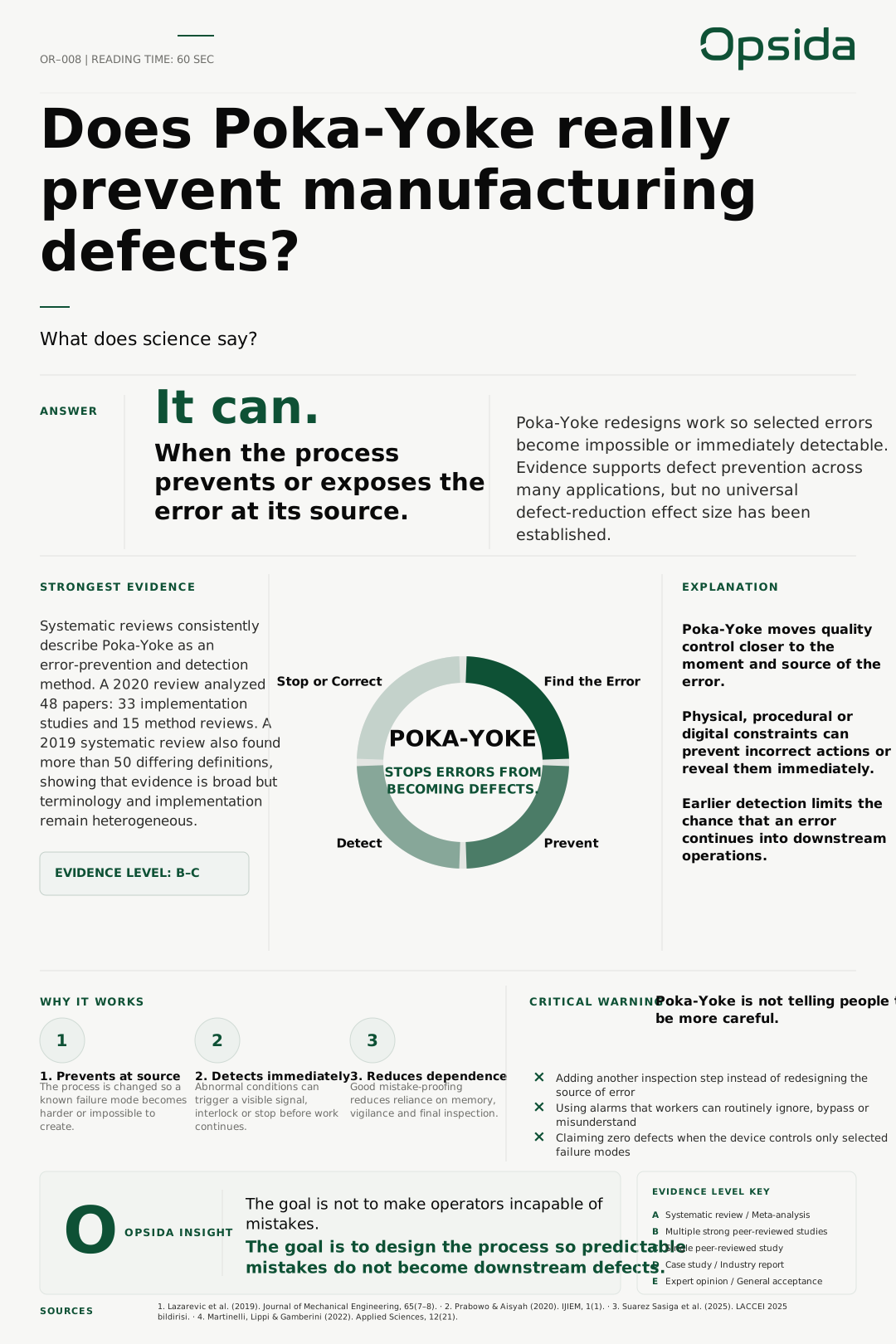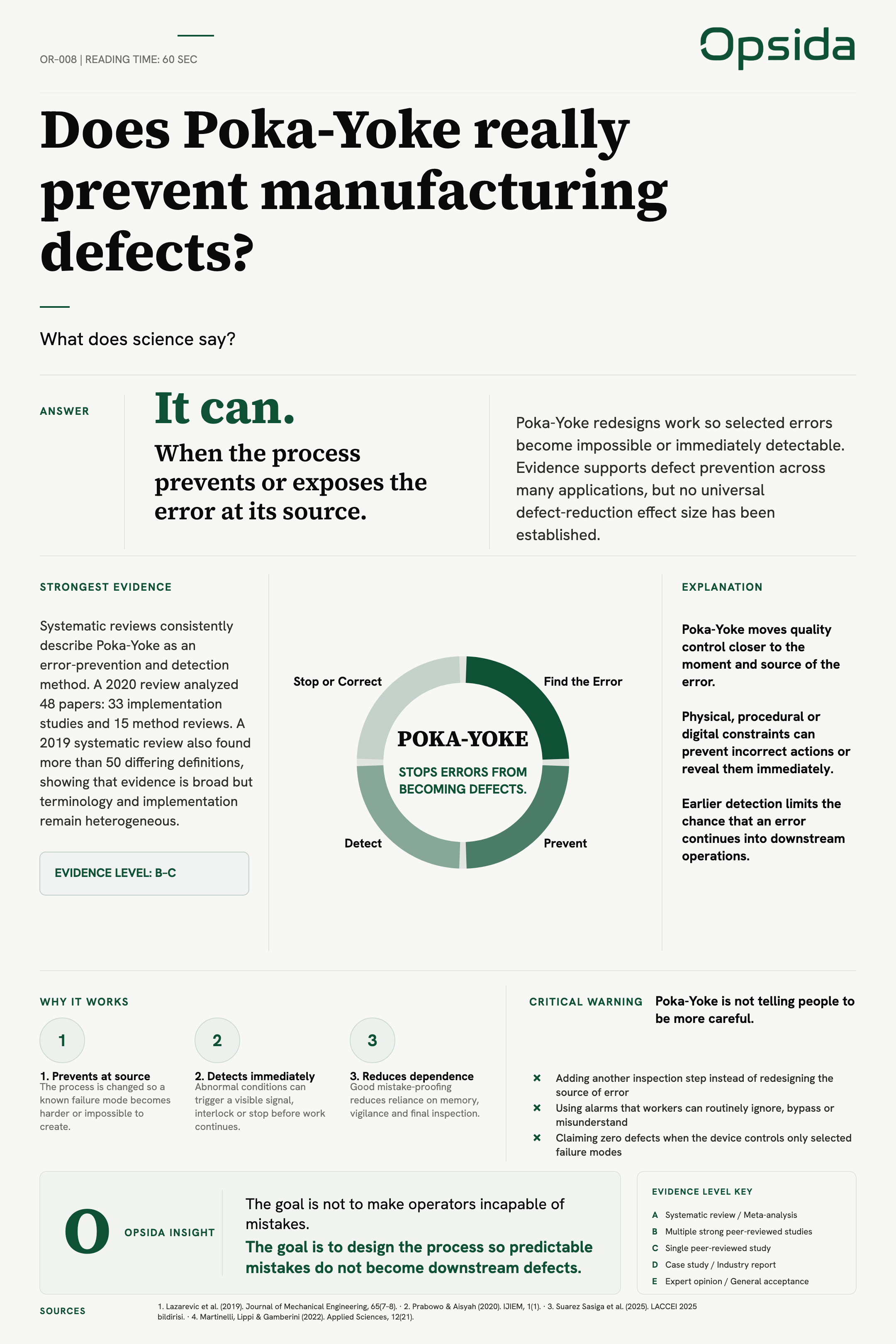
Does Poka-Yoke really prevent manufacturing defects?
What does science say?
Answer
It can.
When the process prevents or exposes the error at its source.
Poka-Yoke redesigns work so selected errors become impossible or immediately detectable. Evidence supports defect prevention across many applications, but no universal defect-reduction effect size has been established.
Strongest evidence
Systematic reviews consistently describe Poka-Yoke as an error-prevention and detection method. A 2020 review analyzed 48 papers: 33 implementation studies and 15 method reviews. A 2019 systematic review also found more than 50 differing definitions, showing that evidence is broad but terminology and implementation remain heterogeneous.
48Poka-Yoke papers reviewed33 implementation papers · 15 method reviews · 2020 systematic literature review
The steps, in order
POKA-YOKE stops errors from becoming defects.
- Find the ErrorIdentify the specific human, process or positioning error that can create a defect.
- PreventRedesign the task or interface so the incorrect action cannot be completed.
- DetectWhen prevention is impractical, expose the abnormal condition immediately.
- Stop or CorrectPrevent the error from moving downstream until the condition is corrected.
Explanation
- Poka-Yoke moves quality control closer to the moment and source of the error.
- Physical, procedural or digital constraints can prevent incorrect actions or reveal them immediately.
- Earlier detection limits the chance that an error continues into downstream operations.
Why it works
Prevents at source
The process is changed so a known failure mode becomes harder or impossible to create.
Detects immediately
Abnormal conditions can trigger a visible signal, interlock or stop before work continues.
Reduces dependence
Good mistake-proofing reduces reliance on memory, vigilance and final inspection.
Critical warning
Poka-Yoke is not telling people to be more careful.
- Adding another inspection step instead of redesigning the source of error
- Using alarms that workers can routinely ignore, bypass or misunderstand
- Claiming zero defects when the device controls only selected failure modes
Opsida insight
The goal is not to make operators incapable of mistakes.
The goal is to design the process so predictable mistakes do not become downstream defects.
Sources
Lazarevic, M., Mandic, J., Sremcev, N., Vukelic, D., & Debevec, M. (2019). A systematic literature review of Poka-Yoke and novel approach to theoretical aspects. Strojniški vestnik - Journal of Mechanical Engineering, 65(7–8), 454–467.
Prabowo, R. F., & Aisyah, S. (2020). Poka-Yoke method implementation in industries: A systematic literature review. IJIEM - Indonesian Journal of Industrial Engineering and Management, 1(1), 12–24.
Suarez Sasiga, C. D., Toque Mamani, M., & Matos Arnao, R. (2025). Impact of Poka Yoke methodology in the manufacturing industry: A systematic literature review (2019–2024). Proceedings of the 23rd LACCEI International Multi-Conference for Engineering, Education and Technology, Mexico City, 16–18 July 2025.
Martinelli, M., Lippi, M., & Gamberini, R. (2022). Poka Yoke meets deep learning: A proof of concept for an assembly line application. Applied Sciences, 12(21), 11071.
Evidence level key
- A
- Systematic review / Meta-analysis
- B
- Multiple strong peer-reviewed studies
- C
- Single peer-reviewed study
- D
- Case study / Industry report
- E
- Expert opinion / General acceptance
Poster
The full issue as a single sheet — the same content, laid out for printing and sharing.