Does SMED really reduce setup time?
What does science say?
Answer
Yes.
When changeover work is redesigned—not merely rushed.
SMED creates value by moving work outside machine downtime, simplifying the remaining internal tasks and standardizing the new method.
Strongest evidence
A state-of-the-art review covering 130 SMED articles shows that the method is widely used to reduce setup and changeover time. Peer-reviewed methodological studies also support its core logic, while warning that the classic sequence is not always the best improvement route for every process.
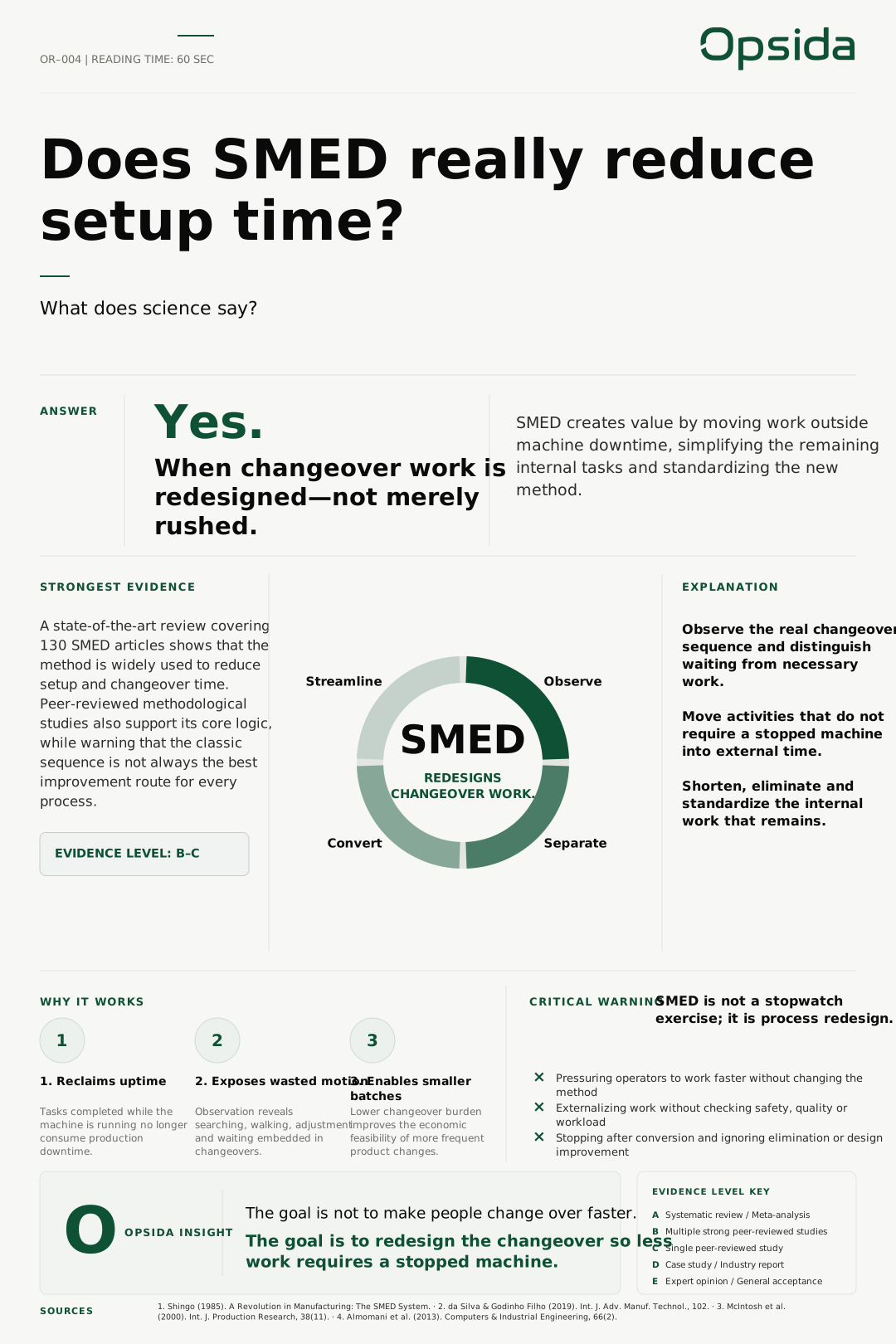
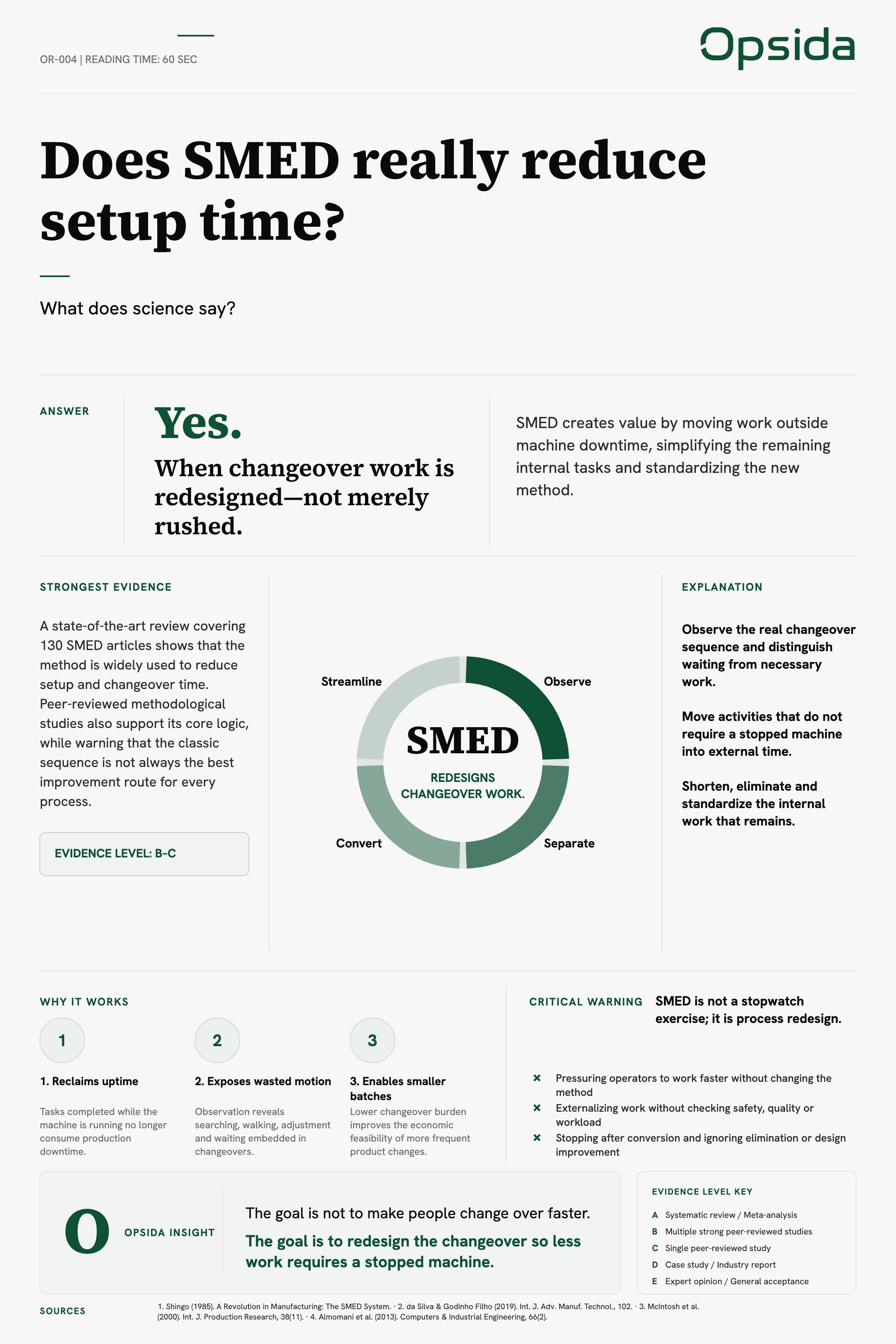
The steps, in order
SMED redesigns changeover work.
- ObserveThe real changeover sequence is watched end to end.
- SeparateInternal and external activities are told apart.
- ConvertInternal work moves outside downtime where possible.
- StreamlineThe remaining internal work is shortened and standardized.
Explanation
- Observe the real changeover sequence and distinguish waiting from necessary work.
- Move activities that do not require a stopped machine into external time.
- Shorten, eliminate and standardize the internal work that remains.
Why it works
Reclaims uptime
Tasks completed while the machine is running no longer consume production downtime.
Exposes wasted motion
Observation reveals searching, walking, adjustment and waiting embedded in changeovers.
Enables smaller batches
Lower changeover burden improves the economic feasibility of more frequent product changes.
Critical warning
SMED is not a stopwatch exercise; it is process redesign.
- Pressuring operators to work faster without changing the method
- Externalizing work without checking safety, quality or workload
- Stopping after conversion and ignoring elimination or design improvement
Opsida insight
The goal is not to make people change over faster.
The goal is to redesign the changeover so less work requires a stopped machine.
Sources
Shingo, S. (1985). A Revolution in Manufacturing: The SMED System. Productivity Press.
da Silva, I. B., & Godinho Filho, M. (2019). Single-minute exchange of die (SMED): a state-of-the-art literature review. The International Journal of Advanced Manufacturing Technology, 102, 4289–4307.
McIntosh, R. I., Culley, S. J., Mileham, A. R., & Owen, G. W. (2000). A critical evaluation of Shingo's 'SMED' (Single Minute Exchange of Die) methodology. International Journal of Production Research, 38(11), 2377–2395.
Almomani, M. A., Aladeemy, M., Abdelhadi, A., & Mumani, A. (2013). A proposed approach for setup time reduction through integrating conventional SMED method with multiple criteria decision-making techniques. Computers & Industrial Engineering, 66(2), 461–469.
Evidence level key
- A
- Systematic review / Meta-analysis
- B
- Multiple strong peer-reviewed studies
- C
- Single peer-reviewed study
- D
- Case study / Industry report
- E
- Expert opinion / General acceptance
Poster
The full issue as a single sheet — the same content, laid out for printing and sharing.