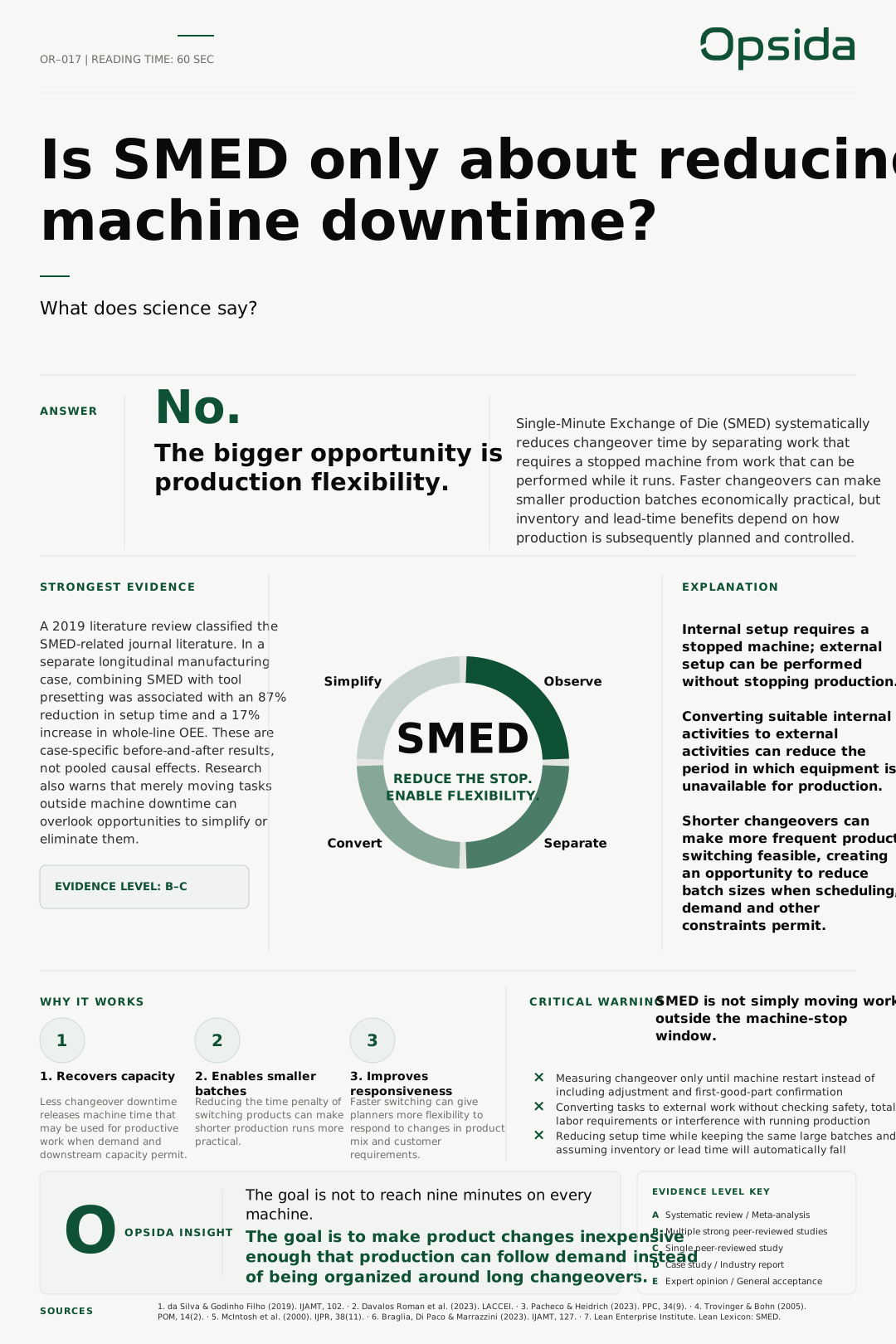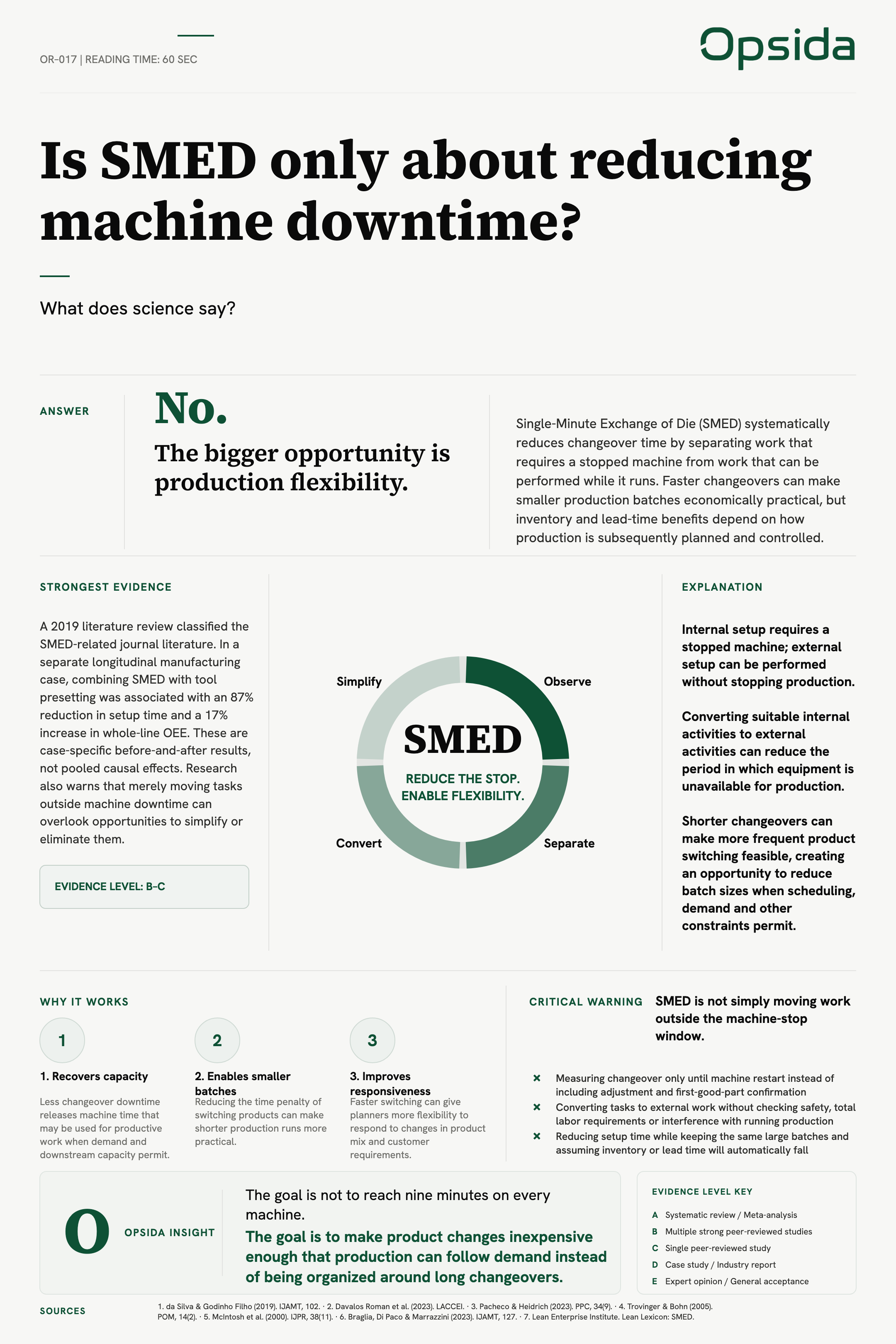
Is SMED only about reducing machine downtime?
What does science say?
Answer
No.
The bigger opportunity is production flexibility.
Single-Minute Exchange of Die (SMED) systematically reduces changeover time by separating work that requires a stopped machine from work that can be performed while it runs. Faster changeovers can make smaller production batches economically practical, but inventory and lead-time benefits depend on how production is subsequently planned and controlled.
Strongest evidence
A 2019 literature review classified the SMED-related journal literature. In a separate longitudinal manufacturing case, combining SMED with tool presetting was associated with an 87% reduction in setup time and a 17% increase in whole-line OEE. These are case-specific before-and-after results, not pooled causal effects. Research also warns that merely moving tasks outside machine downtime can overlook opportunities to simplify or eliminate them.
87setup-time reduction reportedOne longitudinal industrial case combining SMED and tool presetting · Single-site before-and-after result; combined intervention; not a universal causal effect
The steps, in order
SMED reduce the stop. enable flexibility.
- ObserveRecord the complete changeover, including preparation, adjustment and first-good-part confirmation.
- SeparateDistinguish internal tasks requiring machine stoppage from external tasks that can be performed while the machine runs.
- ConvertMove suitable preparation and adjustment tasks outside the machine-stop window.
- SimplifyEliminate unnecessary work, improve tooling and standardize the remaining changeover.
Explanation
- Internal setup requires a stopped machine; external setup can be performed without stopping production.
- Converting suitable internal activities to external activities can reduce the period in which equipment is unavailable for production.
- Shorter changeovers can make more frequent product switching feasible, creating an opportunity to reduce batch sizes when scheduling, demand and other constraints permit.
Why it works
Recovers capacity
Less changeover downtime releases machine time that may be used for productive work when demand and downstream capacity permit.
Enables smaller batches
Reducing the time penalty of switching products can make shorter production runs more practical.
Improves responsiveness
Faster switching can give planners more flexibility to respond to changes in product mix and customer requirements.
Critical warning
SMED is not simply moving work outside the machine-stop window.
- Measuring changeover only until machine restart instead of including adjustment and first-good-part confirmation
- Converting tasks to external work without checking safety, total labor requirements or interference with running production
- Reducing setup time while keeping the same large batches and assuming inventory or lead time will automatically fall
Opsida insight
The goal is not to reach nine minutes on every machine.
The goal is to make product changes inexpensive enough that production can follow demand instead of being organized around long changeovers.
Sources
da Silva, I. B., & Godinho Filho, M. (2019). Single-minute exchange of die (SMED): A state-of-the-art literature review. The International Journal of Advanced Manufacturing Technology, 102, 4289–4307.
Davalos Roman, E. J., Luna Usquiano, E. A., Miñan Olivos, G. S., Valderrama Puscan, M. W., & Rivera Ramírez, Y. V. (2023). Single Minute Exchange of Die (SMED) to improve productivity in the industrial sector: A systematic review of the literature from 2012 to 2022. LACCEI 2023 Conference Proceedings.
Pacheco, D. A. J., & Heidrich, G. D. G. (2023). Revitalising the setup reduction activities in Operations Management. Production Planning & Control, 34(9), 791–811.
Trovinger, S. C., & Bohn, R. E. (2005). Setup time reduction for electronics assembly: Combining simple (SMED) and IT-based methods. Production and Operations Management, 14(2), 205–217.
McIntosh, R. I., Culley, S. J., Mileham, A. R., & Owen, G. W. (2000). A critical evaluation of Shingo's 'SMED' (Single Minute Exchange of Die) methodology. International Journal of Production Research, 38(11), 2377–2395.
Braglia, M., Di Paco, F., & Marrazzini, L. (2023). A new Lean tool for efficiency evaluation in SMED projects. The International Journal of Advanced Manufacturing Technology, 127, 431–446.
Lean Enterprise Institute. Single Minute Exchange of Die. Lean Lexicon.
Evidence level key
- A
- Systematic review / Meta-analysis
- B
- Multiple strong peer-reviewed studies
- C
- Single peer-reviewed study
- D
- Case study / Industry report
- E
- Expert opinion / General acceptance
Poster
The full issue as a single sheet — the same content, laid out for printing and sharing.