Does Standardized Work really improve productivity?
What does science say?
Answer
It can.
But the strongest role is creating stability for improvement.
Standardized Work creates a repeatable baseline, exposes deviation and supports waste reduction. Productivity gains depend on redesign, worker participation and continued kaizen—not documentation alone.
Strongest evidence
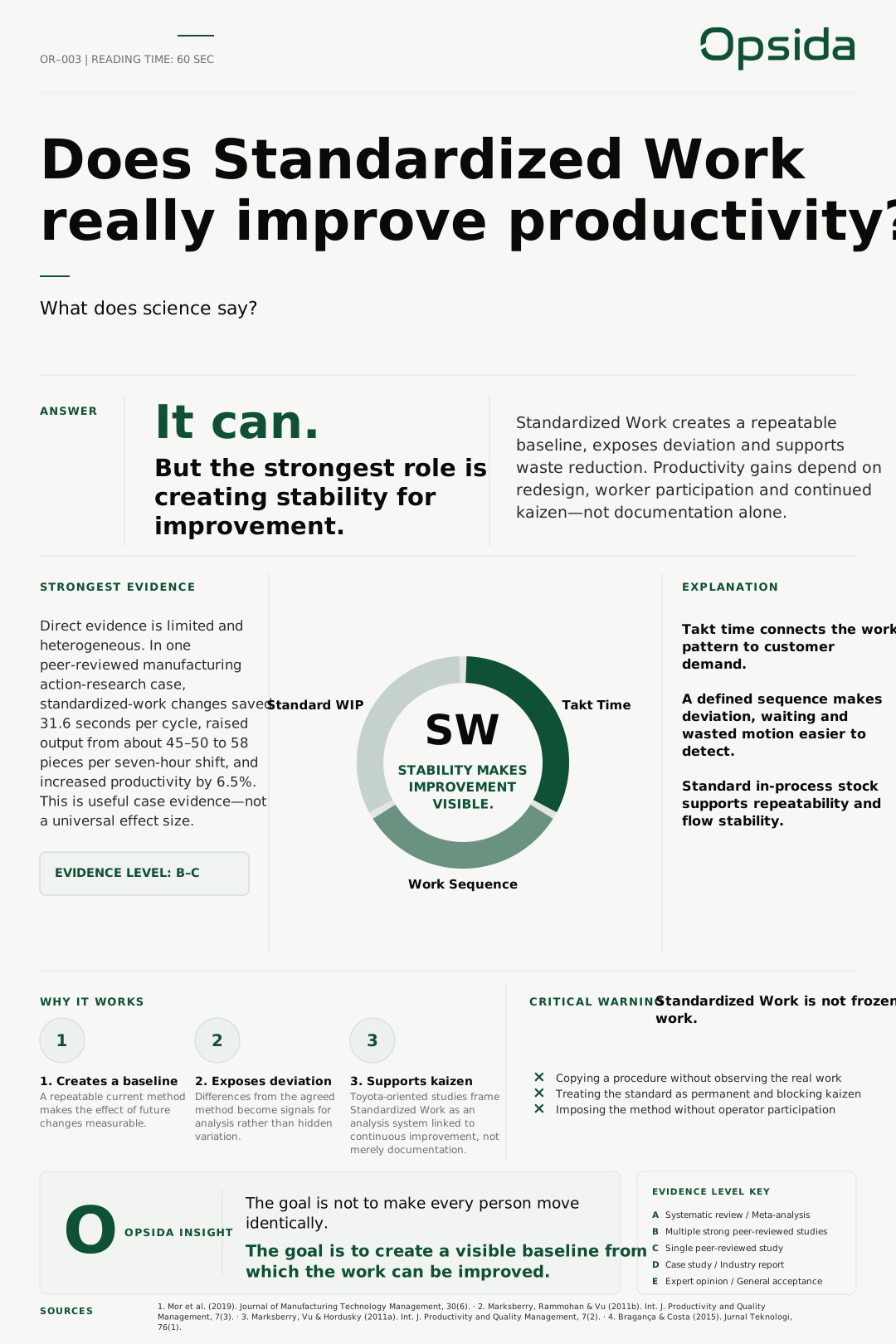
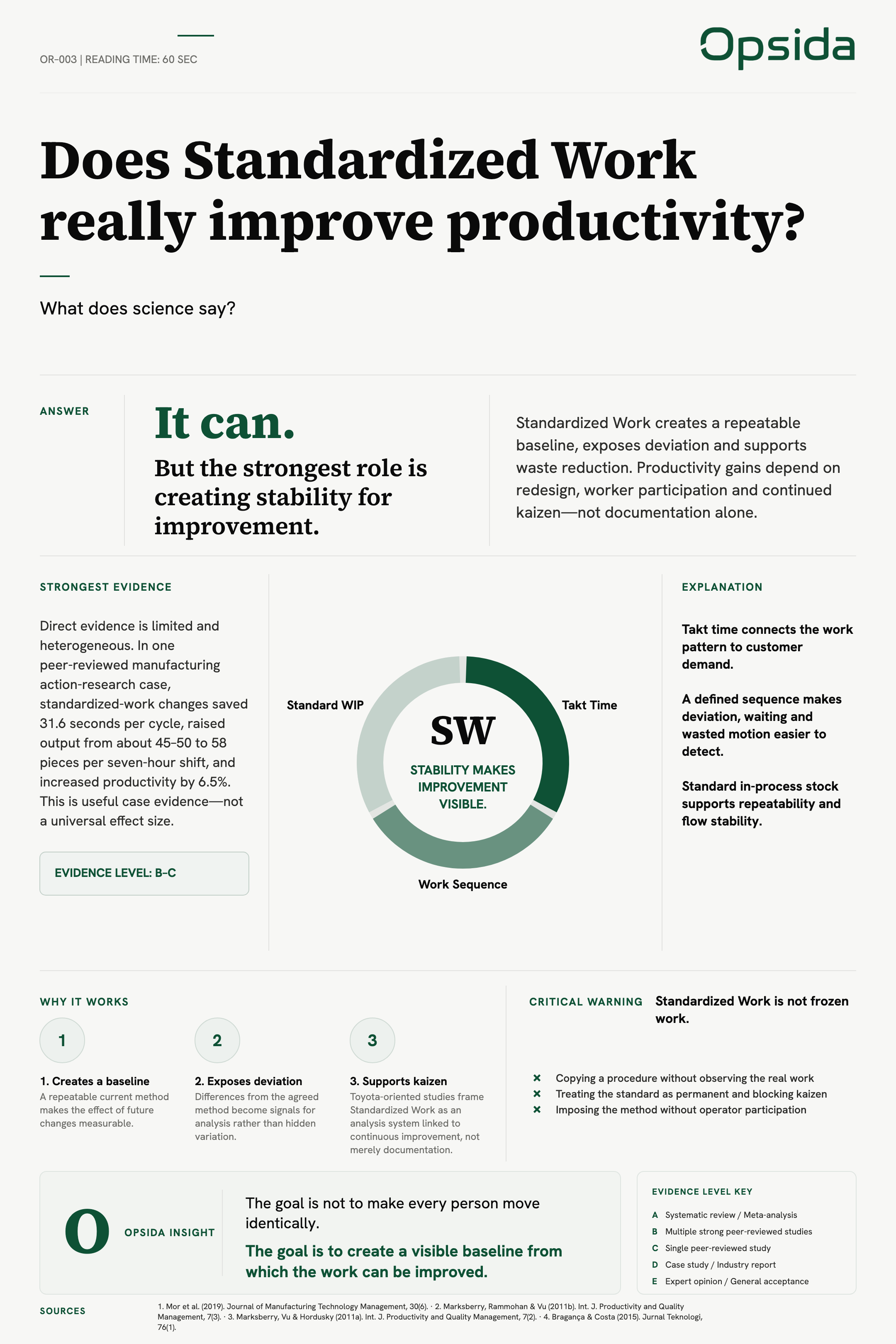
Direct evidence is limited and heterogeneous. In one peer-reviewed manufacturing action-research case, standardized-work changes saved 31.6 seconds per cycle, raised output from about 45–50 to 58 pieces per seven-hour shift, and increased productivity by 6.5%. This is useful case evidence—not a universal effect size.
6.5percent productivity increaseOne core-making workstation in one manufacturing company · Single case study
What it is made of
SW stability makes improvement visible.
- Takt TimeThe work pace set by customer demand.
- Work SequenceThe order in which the steps are performed.
- Standard WIPThe minimum in-process stock the flow needs.
Explanation
- Takt time connects the work pattern to customer demand.
- A defined sequence makes deviation, waiting and wasted motion easier to detect.
- Standard in-process stock supports repeatability and flow stability.
Why it works
Creates a baseline
A repeatable current method makes the effect of future changes measurable.
Exposes deviation
Differences from the agreed method become signals for analysis rather than hidden variation.
Supports kaizen
Toyota-oriented studies frame Standardized Work as an analysis system linked to continuous improvement, not merely documentation.
Critical warning
Standardized Work is not frozen work.
- Copying a procedure without observing the real work
- Treating the standard as permanent and blocking kaizen
- Imposing the method without operator participation
Opsida insight
The goal is not to make every person move identically.
The goal is to create a visible baseline from which the work can be improved.
Sources
Mor, R. S., Bhardwaj, A., Singh, S., & Sachdeva, A. (2019). Productivity gains through standardization-of-work in a manufacturing company. Journal of Manufacturing Technology Management, 30(6), 899–919.
Marksberry, P., Rammohan, R., & Vu, D. (2011b). A systems study on standardised work: a Toyota perspective. International Journal of Productivity and Quality Management, 7(3), 287–303.
Marksberry, P., Vu, D., & Hordusky, B. (2011a). A quantitative investigation of Toyota's approach in teaching standardised work. International Journal of Productivity and Quality Management, 7(2), 148–167.
Bragança, S., & Costa, E. (2015). An application of the Lean Production tool Standard Work. Jurnal Teknologi, 76(1).
Evidence level key
- A
- Systematic review / Meta-analysis
- B
- Multiple strong peer-reviewed studies
- C
- Single peer-reviewed study
- D
- Case study / Industry report
- E
- Expert opinion / General acceptance
Poster
The full issue as a single sheet — the same content, laid out for printing and sharing.