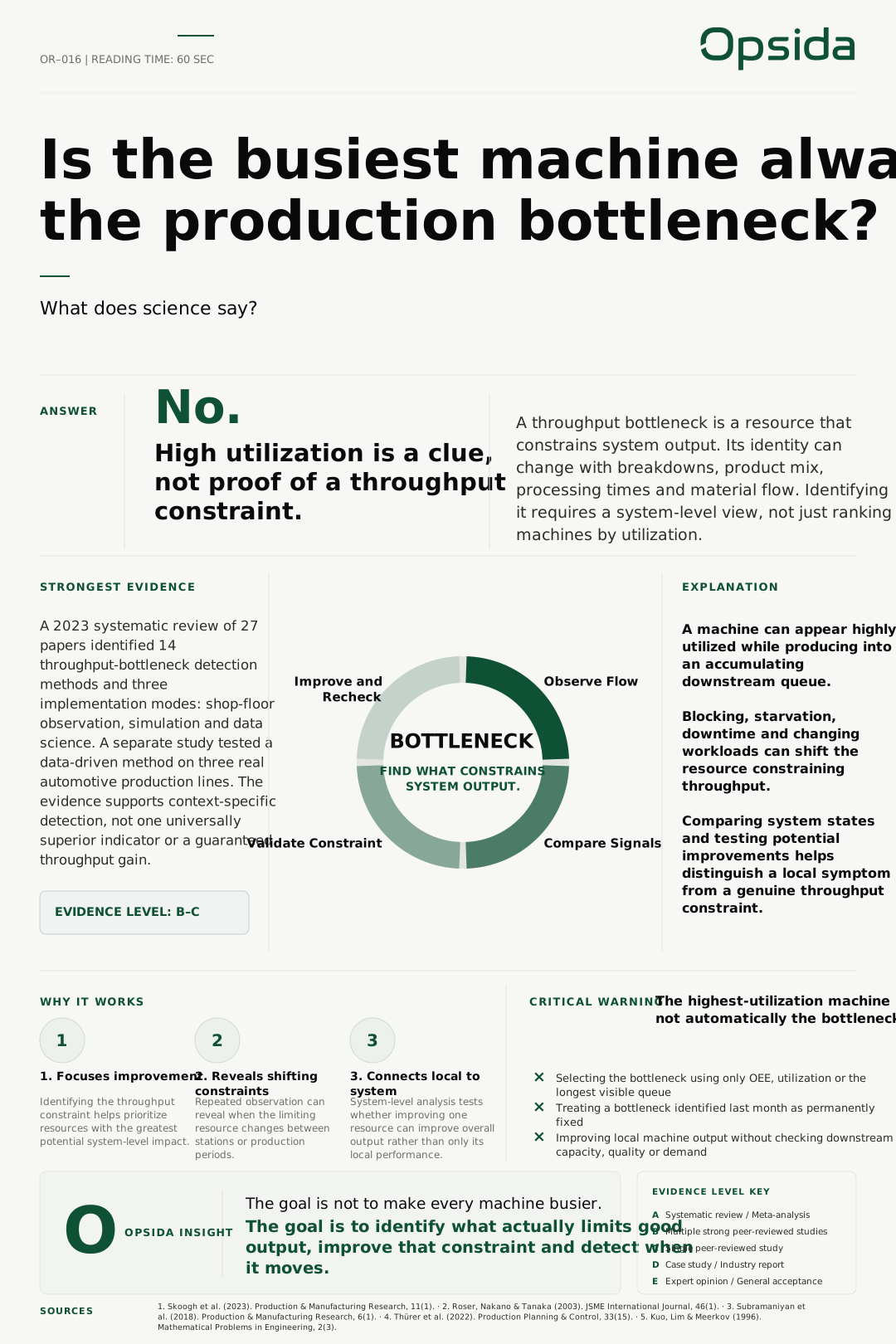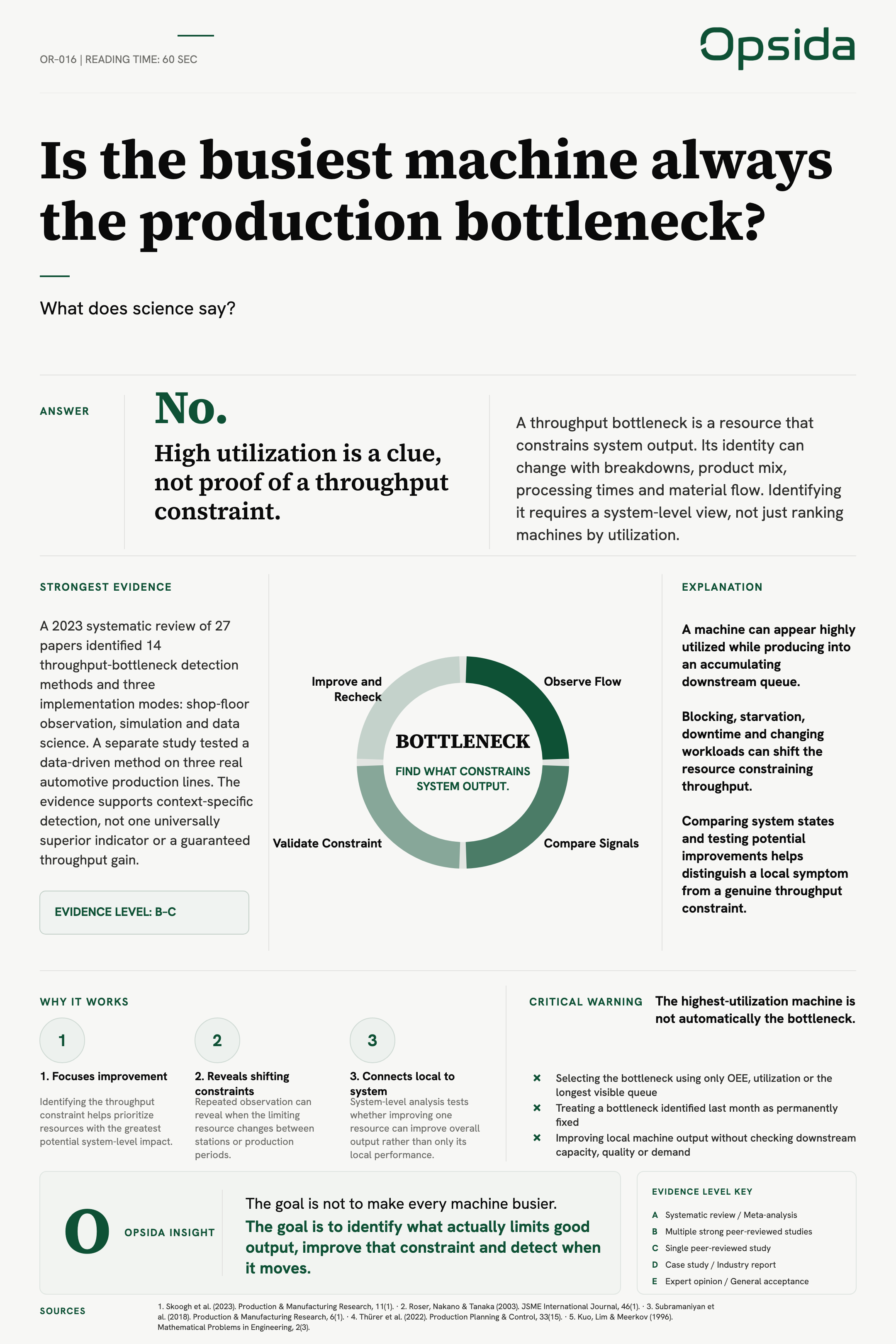
Is the busiest machine always the production bottleneck?
What does science say?
Answer
No.
High utilization is a clue, not proof of a throughput constraint.
A throughput bottleneck is a resource that constrains system output. Its identity can change with breakdowns, product mix, processing times and material flow. Identifying it requires a system-level view, not just ranking machines by utilization.
Strongest evidence
A 2023 systematic review of 27 papers identified 14 throughput-bottleneck detection methods and three implementation modes: shop-floor observation, simulation and data science. A separate study tested a data-driven method on three real automotive production lines. The evidence supports context-specific detection, not one universally superior indicator or a guaranteed throughput gain.
14bottleneck detection methods identified27 papers analyzed · 3 operationalization modes · 2023 systematic literature review; method count, not an effectiveness estimate
The steps, in order
BOTTLENECK find what constrains system output.
- Observe FlowExamine queues, blocked stations, starved stations and actual process states.
- Compare SignalsUse suitable measures such as utilization, active periods, queue states or their combination.
- Validate ConstraintCheck whether the suspected resource actually constrains system throughput.
- Improve and RecheckAddress the verified constraint and reassess the system as the bottleneck may shift.
Explanation
- A machine can appear highly utilized while producing into an accumulating downstream queue.
- Blocking, starvation, downtime and changing workloads can shift the resource constraining throughput.
- Comparing system states and testing potential improvements helps distinguish a local symptom from a genuine throughput constraint.
Why it works
Focuses improvement
Identifying the throughput constraint helps prioritize resources with the greatest potential system-level impact.
Reveals shifting constraints
Repeated observation can reveal when the limiting resource changes between stations or production periods.
Connects local to system
System-level analysis tests whether improving one resource can improve overall output rather than only its local performance.
Critical warning
The highest-utilization machine is not automatically the bottleneck.
- Selecting the bottleneck using only OEE, utilization or the longest visible queue
- Treating a bottleneck identified last month as permanently fixed
- Improving local machine output without checking downstream capacity, quality or demand
Opsida insight
The goal is not to make every machine busier.
The goal is to identify what actually limits good output, improve that constraint and detect when it moves.
Sources
Skoogh, A., Thürer, M., Subramaniyan, M., Matta, A., & Roser, C. (2023). Throughput bottleneck detection in manufacturing: A systematic review of the literature on methods and operationalization modes. Production & Manufacturing Research, 11(1), 2283031.
Roser, C., Nakano, M., & Tanaka, M. (2003). Constraint management in manufacturing systems. JSME International Journal Series C, 46(1), 73–80.
Subramaniyan, M., Skoogh, A., Salomonsson, H., Bangalore, P., Gopalakrishnan, M., & Sheikh Muhammad, A. (2018). Data-driven algorithm for throughput bottleneck analysis of production systems. Production & Manufacturing Research, 6(1), 225–246.
Thürer, M., Ma, L., Stevenson, M., & Roser, C. (2022). Bottleneck detection in high-variety make-to-order shops with complex routings: An assessment by simulation. Production Planning & Control, 33(15), 1481–1492.
Kuo, C.-T., Lim, J.-T., & Meerkov, S. M. (1996). Bottlenecks in serial production lines: A system-theoretic approach. Mathematical Problems in Engineering, 2(3), 233–276.
Evidence level key
- A
- Systematic review / Meta-analysis
- B
- Multiple strong peer-reviewed studies
- C
- Single peer-reviewed study
- D
- Case study / Industry report
- E
- Expert opinion / General acceptance
Poster
The full issue as a single sheet — the same content, laid out for printing and sharing.