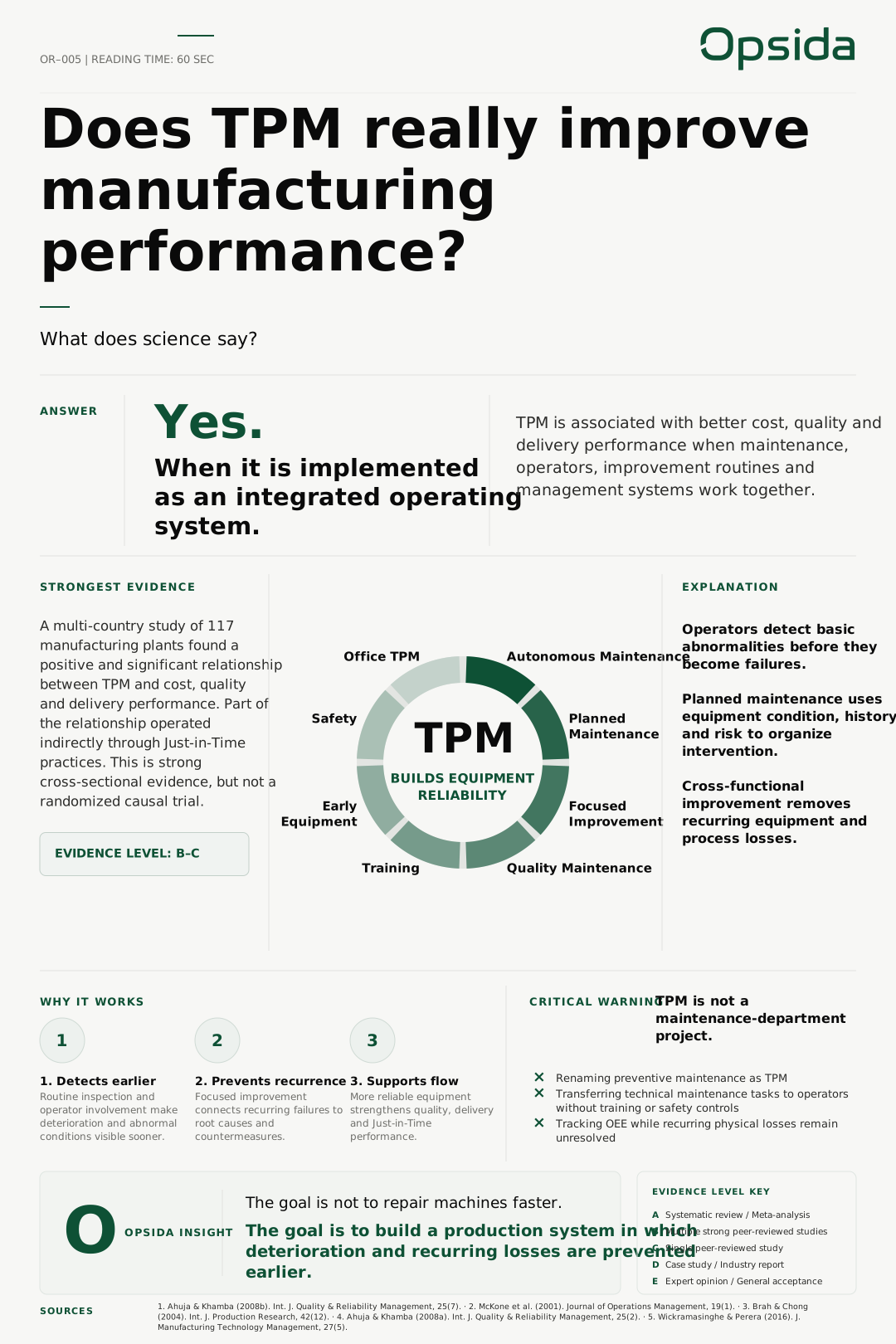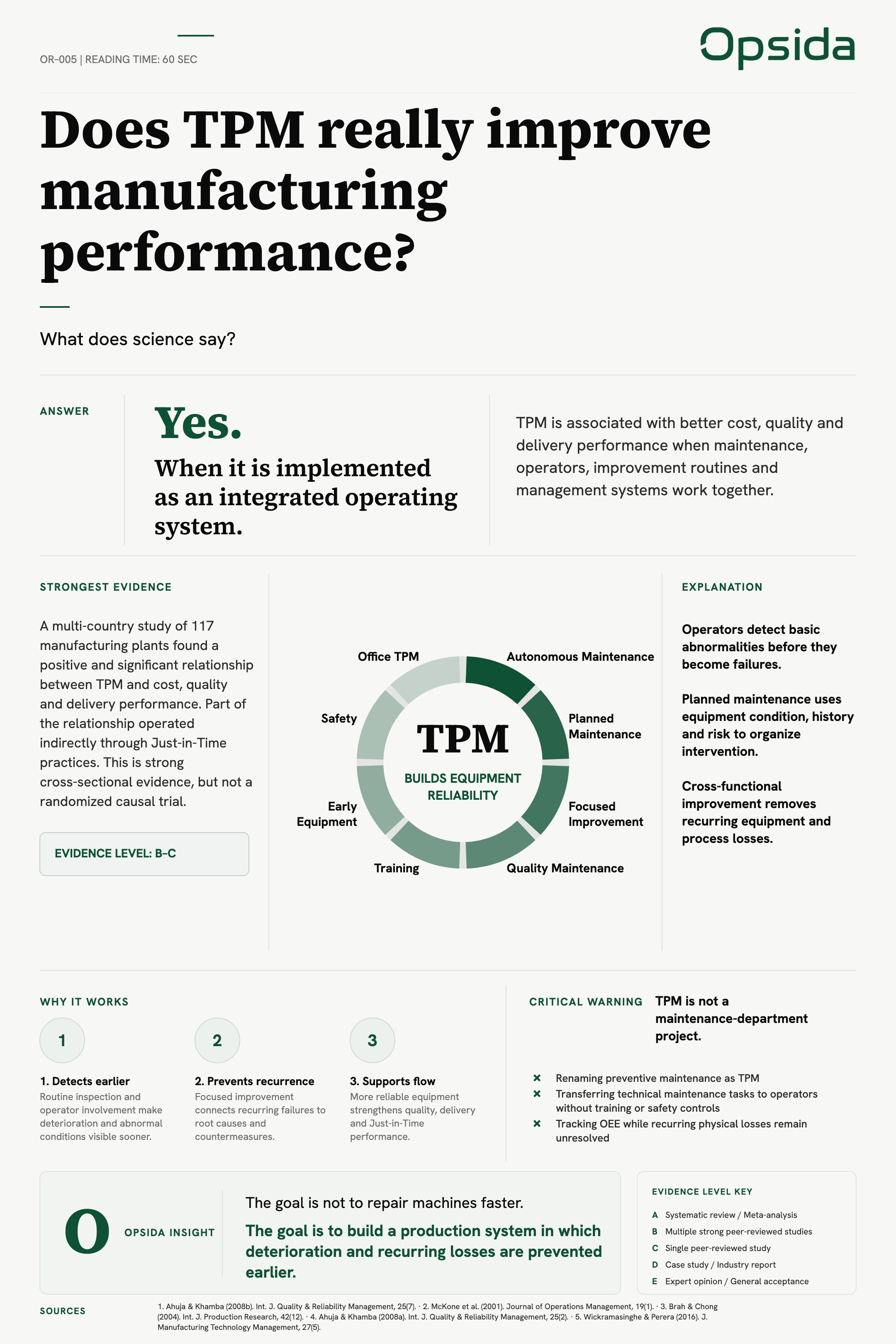
Does TPM really improve manufacturing performance?
What does science say?
Answer
Yes.
When it is implemented as an integrated operating system.
TPM is associated with better cost, quality and delivery performance when maintenance, operators, improvement routines and management systems work together.
Strongest evidence
A multi-country study of 117 manufacturing plants found a positive and significant relationship between TPM and cost, quality and delivery performance. Part of the relationship operated indirectly through Just-in-Time practices. This is strong cross-sectional evidence, but not a randomized causal trial.
117manufacturing plants studied3 industries · 4 countries
What it is made of
TPM builds equipment reliability
- Autonomous Maintenance
- Planned Maintenance
- Focused Improvement
- Quality Maintenance
- Training
- Early Equipment
- Safety
- Office TPM
Explanation
- Operators detect basic abnormalities before they become failures.
- Planned maintenance uses equipment condition, history and risk to organize intervention.
- Cross-functional improvement removes recurring equipment and process losses.
Why it works
Detects earlier
Routine inspection and operator involvement make deterioration and abnormal conditions visible sooner.
Prevents recurrence
Focused improvement connects recurring failures to root causes and countermeasures.
Supports flow
More reliable equipment strengthens quality, delivery and Just-in-Time performance.
Critical warning
TPM is not a maintenance-department project.
- Renaming preventive maintenance as TPM
- Transferring technical maintenance tasks to operators without training or safety controls
- Tracking OEE while recurring physical losses remain unresolved
Opsida insight
The goal is not to repair machines faster.
The goal is to build a production system in which deterioration and recurring losses are prevented earlier.
Sources
Ahuja, I. P. S., & Khamba, J. S. (2008b). Total productive maintenance: literature review and directions. International Journal of Quality & Reliability Management, 25(7), 709–756.
McKone, K. E., Schroeder, R. G., & Cua, K. O. (2001). The impact of total productive maintenance practices on manufacturing performance. Journal of Operations Management, 19(1), 39–58.
Brah, S. A., & Chong, W. K. (2004). Relationship between total productive maintenance and performance. International Journal of Production Research, 42(12), 2383–2401.
Ahuja, I. P. S., & Khamba, J. S. (2008a). An evaluation of TPM initiatives in Indian industry for enhanced manufacturing performance. International Journal of Quality & Reliability Management, 25(2), 147–172.
Wickramasinghe, G. L. D., & Perera, A. (2016). Effect of total productive maintenance practices on manufacturing performance: Investigation of textile and apparel manufacturing firms. Journal of Manufacturing Technology Management, 27(5), 713–729.
Evidence level key
- A
- Systematic review / Meta-analysis
- B
- Multiple strong peer-reviewed studies
- C
- Single peer-reviewed study
- D
- Case study / Industry report
- E
- Expert opinion / General acceptance
Poster
The full issue as a single sheet — the same content, laid out for printing and sharing.