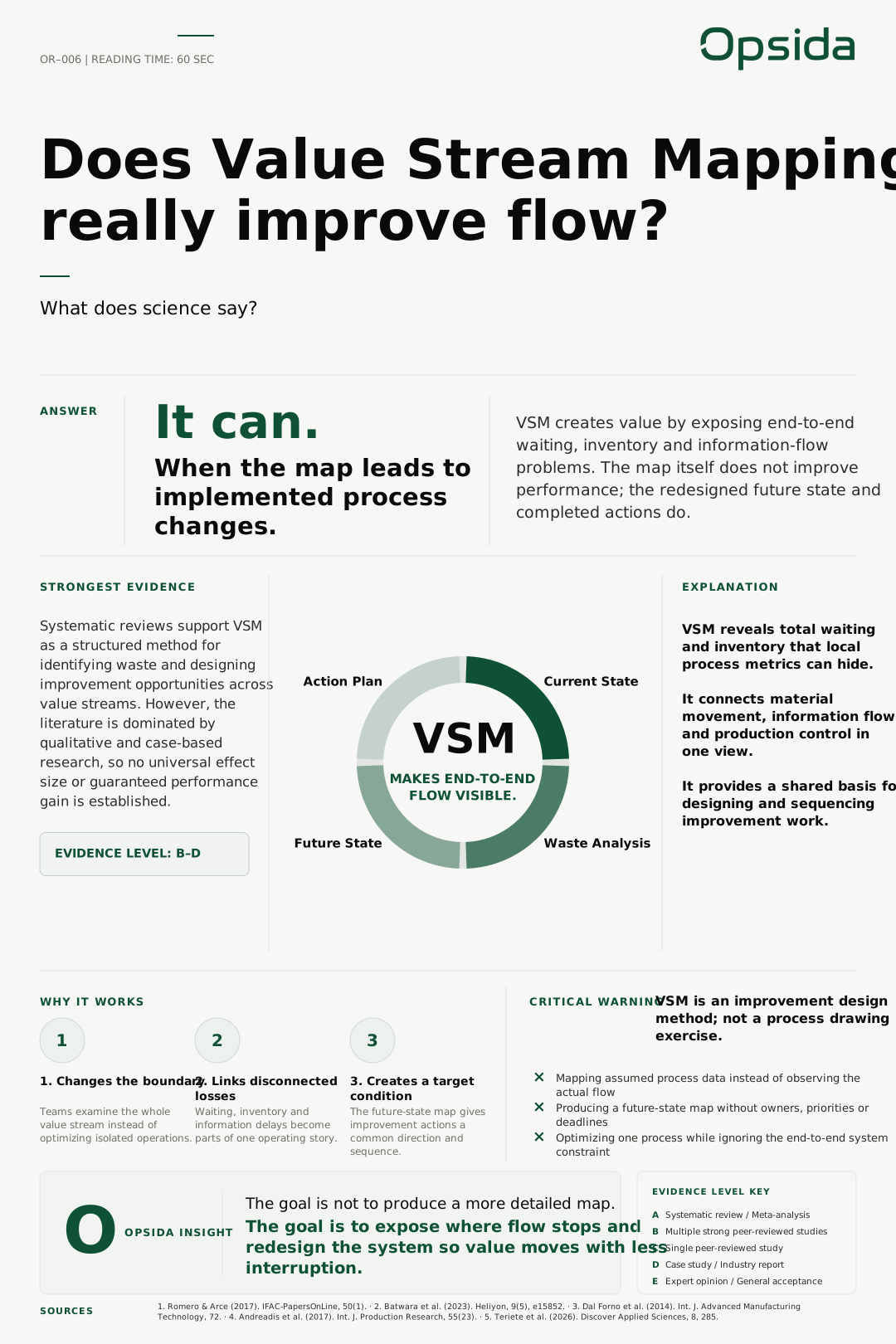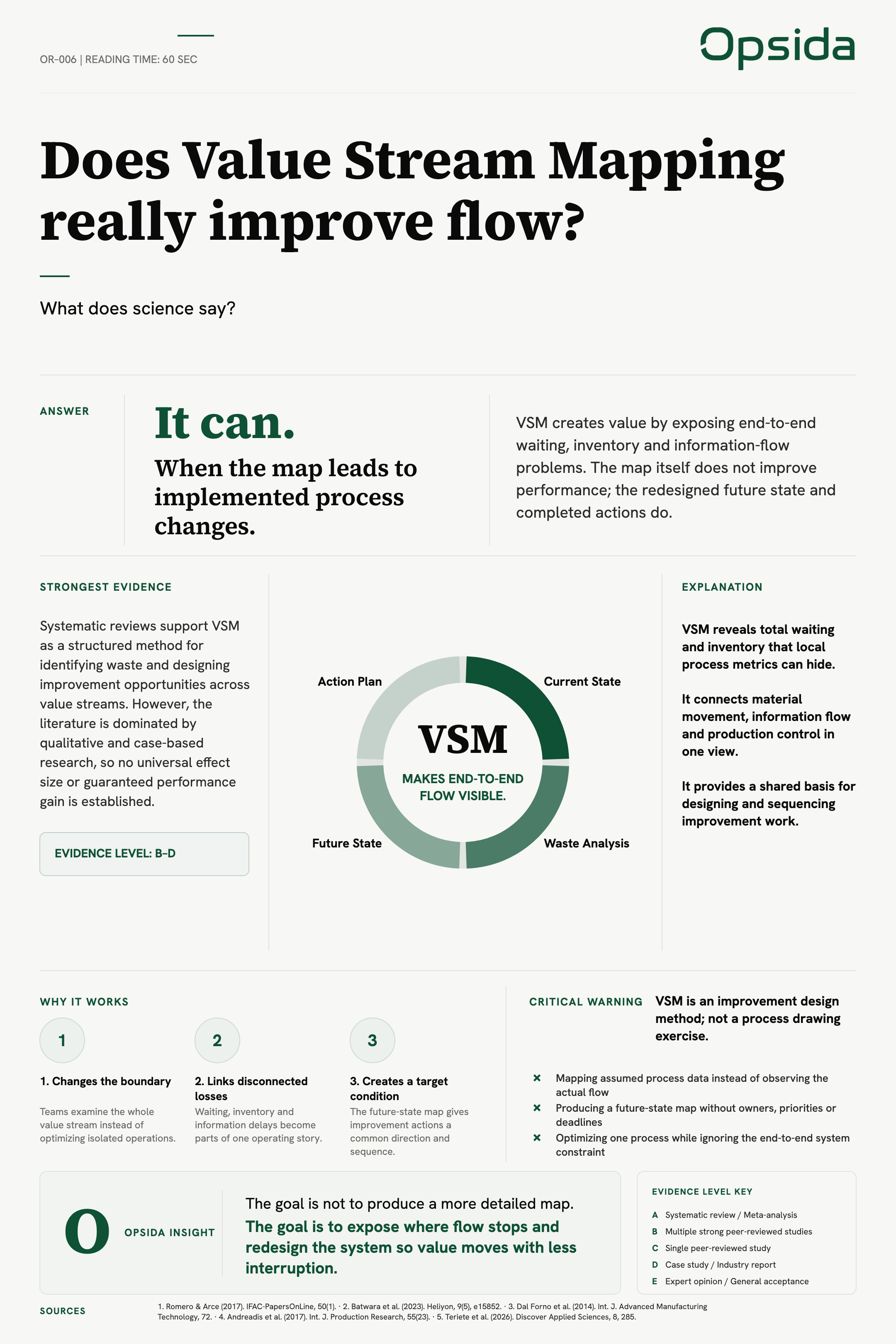
Does Value Stream Mapping really improve flow?
What does science say?
Answer
It can.
When the map leads to implemented process changes.
VSM creates value by exposing end-to-end waiting, inventory and information-flow problems. The map itself does not improve performance; the redesigned future state and completed actions do.
Strongest evidence
Systematic reviews support VSM as a structured method for identifying waste and designing improvement opportunities across value streams. However, the literature is dominated by qualitative and case-based research, so no universal effect size or guaranteed performance gain is established.
21digital VSM and process-mining records included21 included from 2,682 initially identified records · Digital VSM and process-mining systematic review
The steps, in order
VSM makes end-to-end flow visible.
- Current StateObserve the actual material and information flow from request to delivery.
- Waste AnalysisIdentify waiting, inventory, rework, handoffs and disconnected information.
- Future StateDesign a more continuous and demand-linked target flow.
- Action PlanConvert the future-state design into owned and sequenced improvements.
Explanation
- VSM reveals total waiting and inventory that local process metrics can hide.
- It connects material movement, information flow and production control in one view.
- It provides a shared basis for designing and sequencing improvement work.
Why it works
Changes the boundary
Teams examine the whole value stream instead of optimizing isolated operations.
Links disconnected losses
Waiting, inventory and information delays become parts of one operating story.
Creates a target condition
The future-state map gives improvement actions a common direction and sequence.
Critical warning
VSM is an improvement design method; not a process drawing exercise.
- Mapping assumed process data instead of observing the actual flow
- Producing a future-state map without owners, priorities or deadlines
- Optimizing one process while ignoring the end-to-end system constraint
Opsida insight
The goal is not to produce a more detailed map.
The goal is to expose where flow stops and redesign the system so value moves with less interruption.
Sources
Romero, L. F., & Arce, A. (2017). Applying Value Stream Mapping in manufacturing: A systematic literature review. IFAC-PapersOnLine, 50(1), 1075–1086.
Batwara, A., Sharma, V., Makkar, M., & Giallanza, A. (2023). Towards smart sustainable development through value stream mapping: A systematic literature review. Heliyon, 9(5), e15852.
Dal Forno, A. J., Pereira, F. A., Forcellini, F. A., & Kipper, L. M. (2014). Value Stream Mapping: A study about the problems and challenges found in the literature from the past 15 years about application of Lean tools. The International Journal of Advanced Manufacturing Technology, 72, 779–790.
Andreadis, E., Garza-Reyes, J. A., & Kumar, V. (2017). Towards a conceptual framework for value stream mapping implementation: An investigation of managerial factors. International Journal of Production Research, 55(23), 7073–7095.
Teriete, T., Erlach, K., Bauernhansl, T., & van der Aalst, W. M. P. (2026). Combining value stream mapping and process mining in production: A systematic literature review. Discover Applied Sciences, 8, 285.
Evidence level key
- A
- Systematic review / Meta-analysis
- B
- Multiple strong peer-reviewed studies
- C
- Single peer-reviewed study
- D
- Case study / Industry report
- E
- Expert opinion / General acceptance
Poster
The full issue as a single sheet — the same content, laid out for printing and sharing.